Thirty-One Seconds
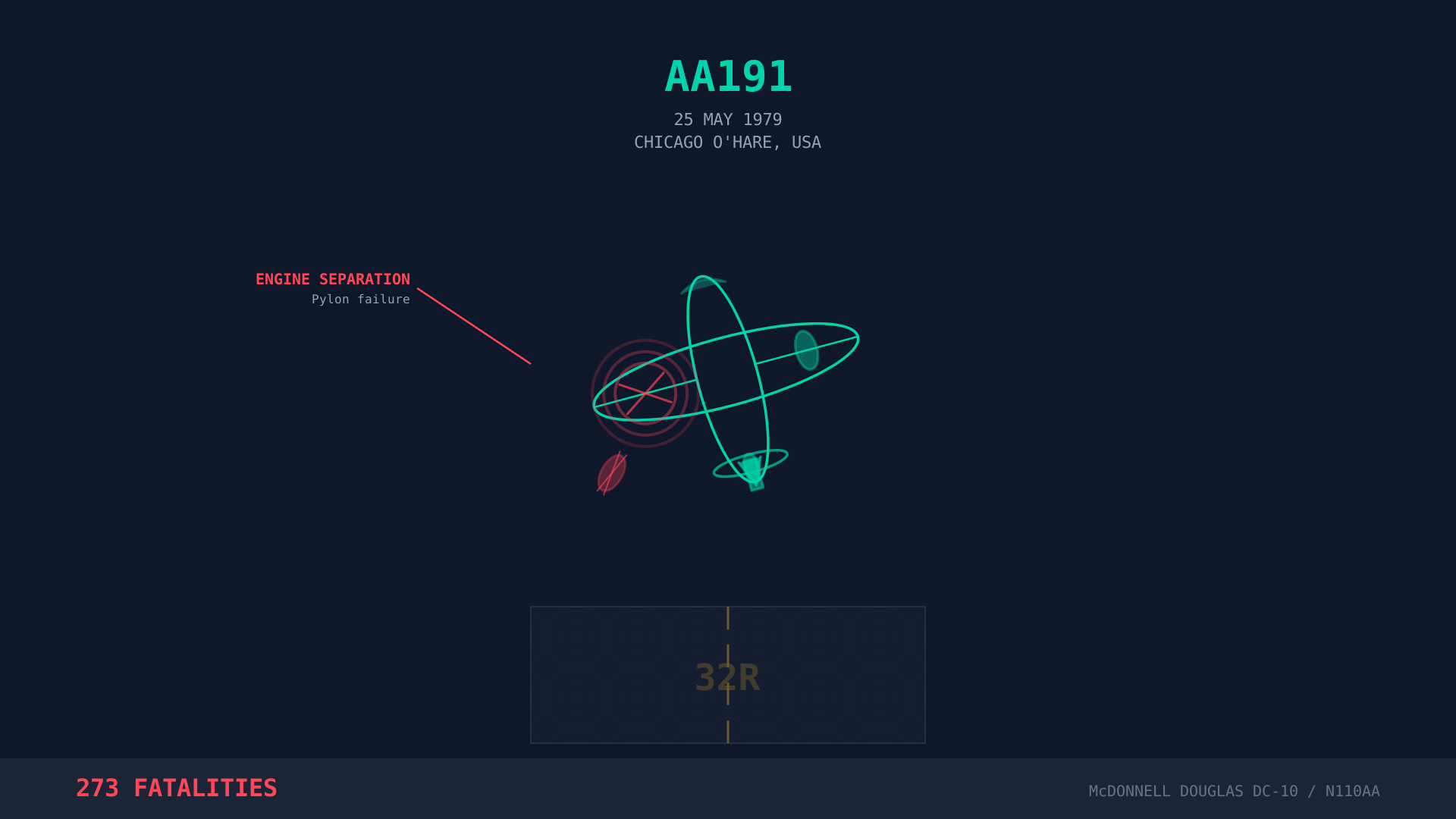
On May 25, 1979, the Friday afternoon of Memorial Day weekend, American Airlines Flight 191 rolled down Runway 32R at Chicago's O'Hare International Airport, packed with vacationers heading to Los Angeles. Just 31 seconds later, the McDonnell Douglas DC-10 would crash into an open field near the airport, killing all 271 people aboard and two on the ground. It remains the deadliest aviation accident in United States history.
A Holiday Weekend Flight
Flight 191 was a routine domestic service from Chicago to Los Angeles International Airport. The DC-10-10, registered as N110AA, was a tri-jet wide-body aircraft—one of the most advanced commercial aircraft of its era. Captain Walter Lux, 53, commanded the flight, assisted by First Officer James Dillard, 49, and Flight Engineer Alfred Udovich, 56. Together, they had over 45,000 hours of flying experience.
The aircraft carried 258 passengers, many of them families embarking on Memorial Day weekend vacations. The flight was nearly full, representing American Airlines' strong traffic on this popular transcontinental route.
The Takeoff
At approximately 3:02 PM Central Daylight Time, Flight 191 began its takeoff roll on Runway 32R. The weather was clear, with light winds—perfect flying conditions. As the heavily loaded DC-10 accelerated down the runway, everything appeared normal.
At 3:02:38 PM, as the aircraft reached V1 (the decision speed beyond which takeoff must continue), witnesses on the ground and in the control tower saw something shocking: the left engine and its pylon assembly—weighing approximately 13,500 pounds—separated from the wing and flipped up and over, falling behind and to the left of the aircraft.
The Critical Seconds
Captain Lux, feeling the aircraft yaw left from the asymmetric thrust, instinctively applied right rudder to maintain directional control. The DC-10 lifted off the runway at 3:02:46 PM. To observers, the aircraft appeared to be climbing normally despite the missing engine—a testament to the power of the two remaining engines and Captain Lux's skill.
But catastrophic damage had occurred that was not immediately apparent to the crew. When the engine and pylon separated, they severed hydraulic lines and damaged the leading edge slats on the left wing. More critically, the separation damaged electrical connections that powered instrumentation warning systems.
The crew had no indication that:
- Their left leading-edge slats had retracted
- Their stall warning system had been disabled
- Their left wing had lost most of its lift capability
Loss of Control
As the aircraft climbed and accelerated, Captain Lux followed the emergency procedure for engine failure after takeoff: maintain V2 speed (the safe single-engine climb speed) and establish a climbing attitude. This was exactly what pilots were trained to do, and it would have been correct in a normal engine-out situation.
However, Flight 191's situation was far from normal. With the leading-edge slats retracted on the left wing but extended on the right wing, the aircraft experienced asymmetric lift. The damaged left wing began to lose lift as the aircraft slowed to V2 speed.
At approximately 325 feet above the ground, the damaged left wing stalled. The aircraft began to roll left. Captain Lux fought to control the aircraft, but without understanding the true nature of the damage, he was fighting a losing battle.
The Crash
At 3:03:09 PM—just 31 seconds after rotation—the DC-10 rolled past 90 degrees and began an inverted descent. The aircraft struck an open field approximately 4,600 feet northwest of the runway, hitting a small abandoned hangar before impacting the ground.
The crash was immediately followed by a massive fireball. The aircraft disintegrated on impact, with wreckage and burning fuel scattered across the field and into a nearby mobile home park. All 271 people aboard the aircraft died instantly. Two people on the ground—who were in the mobile home park—also perished, bringing the total death toll to 273.
Witnesses described a scene of horror: a massive aircraft rolling onto its back and falling from the sky, followed by an explosion and tower of black smoke visible for miles. For those who saw it happen, the image would be seared into memory forever.
The Investigation
The National Transportation Safety Board's investigation revealed a shocking chain of failures in maintenance procedures and aircraft design.
The Root Cause: Improper Maintenance
Between March 29 and 30, 1979—less than two months before the crash—American Airlines maintenance personnel had performed an engine change on N110AA at their facility in Tulsa, Oklahoma. To save time, American had developed a shortcut procedure: instead of removing the engine and pylon separately (as recommended by McDonnell Douglas), they removed the entire engine/pylon assembly using a large forklift.
This procedure was not approved by the manufacturer and required extremely precise positioning of the forklift. During the March maintenance procedure, the pylon flange had come into contact with the wing-mounted pylon aft bulkhead, causing microscopic cracks to develop in the flange's aft bulkhead.
Over the following weeks and approximately 30 flights, these fatigue cracks propagated. On May 25, during the high loads of takeoff, the damaged structure finally failed catastrophically.
Contributing Factors
Design Vulnerability: The DC-10's design concentrated critical systems—hydraulics, electrical connections, and slat controls—in an area vulnerable to damage from pylon separation. A single point of failure could compromise multiple systems.
Emergency Procedure Inadequacy: The engine failure procedure prescribed slowing to V2 speed. In a normal engine-out situation, this was correct. However, with asymmetric slat configuration, maintaining V2 speed led directly to the stall. The procedure assumed all other systems remained functional.
Instrumentation Failure: The damage to electrical systems meant the crew had no stall warning, no slat position indication, and no way to know the true nature of their emergency. They were effectively flying blind to the real problem.
Industry-Wide Issues
The investigation revealed that American Airlines wasn't alone in using improper maintenance procedures. Continental and United Airlines had also developed similar shortcuts. Inspection of DC-10 fleets worldwide found 32 airframes with cracks in the same area—including six that were deemed dangerous.
Immediate Aftermath
On June 6, 1979—less than two weeks after the crash—the FAA took the unprecedented step of suspending the DC-10's type certificate, effectively grounding all DC-10 aircraft operating in U.S. airspace. Other countries quickly followed. The grounding lasted 37 days, representing a major crisis for McDonnell Douglas and DC-10 operators worldwide.
The DC-10 was eventually cleared to return to service after inspections and modifications, but the aircraft's reputation never fully recovered. Airlines gradually phased out the type, and production ended in 1988.
Safety Improvements
The Flight 191 disaster led to numerous safety enhancements:
Maintenance Procedures: The FAA strengthened oversight of airline maintenance procedures and prohibited shortcuts not explicitly approved by manufacturers. Maintenance facilities could no longer independently develop procedures for critical operations.
Design Redundancy: Aircraft manufacturers enhanced redundancy in critical systems, ensuring that a single point of failure could not compromise multiple independent systems.
Engine Mount Design: Future aircraft designs incorporated better isolation of systems and more robust engine mounting structures.
Inspection Protocols: Enhanced inspection requirements for engine pylons and mounting structures were implemented across the industry.
Emergency Procedures: Recognition that emergency procedures must account for multiple-system failures, not just single-point failures.
Memorial
In October 2011, a memorial was dedicated near the crash site in Des Plaines, Illinois. The memorial features a curved wall with the names of all 273 victims and provides a place for families and visitors to remember those lost.
Every May 25, families gather at the memorial to commemorate their loved ones. For many, the pain remains fresh—parents who lost children, children who lost parents, and friends and colleagues whose lives were forever changed.
Legacy
American Airlines Flight 191 demonstrated that even a seemingly simple maintenance procedure, when performed incorrectly, can have catastrophic consequences. The disaster revealed vulnerabilities in both aircraft design and maintenance oversight that prompted fundamental changes in how the industry approaches safety.
The accident also highlighted the cruel paradox of modern aviation: a crew performing exactly as trained, following emergency procedures precisely, yet still doomed by circumstances beyond their control and knowledge. Captain Lux and his crew did everything right based on the information available to them, yet the hidden damage to their aircraft made tragedy inevitable.
Today, the lessons of Flight 191 continue to influence aviation maintenance practices and aircraft design. The 273 victims—families heading on vacation, business travelers, experienced flight crew—did not die in vain. Their tragedy drove improvements that have prevented similar accidents and saved countless lives in the decades since that terrible Memorial Day weekend.
The DC-10 eventually gave way to modern wide-body aircraft with more robust designs and better system redundancy. But the fundamental lesson remains unchanged: in aviation, there are no acceptable shortcuts. Every procedure must be followed precisely, every inspection performed thoroughly, and every warning heeded. The alternative, as Flight 191 so terribly demonstrated, is measured in human lives.