The Day Concorde Fell
On the afternoon of July 25, 2000, Air France Flight 4590—a chartered Concorde supersonic airliner—rolled down Runway 26 Right at Paris Charles de Gaulle Airport, accelerating toward its takeoff speed of 225 mph. The sleek, delta-winged aircraft was bound for New York, carrying mostly German tourists on their way to board a Caribbean cruise ship.
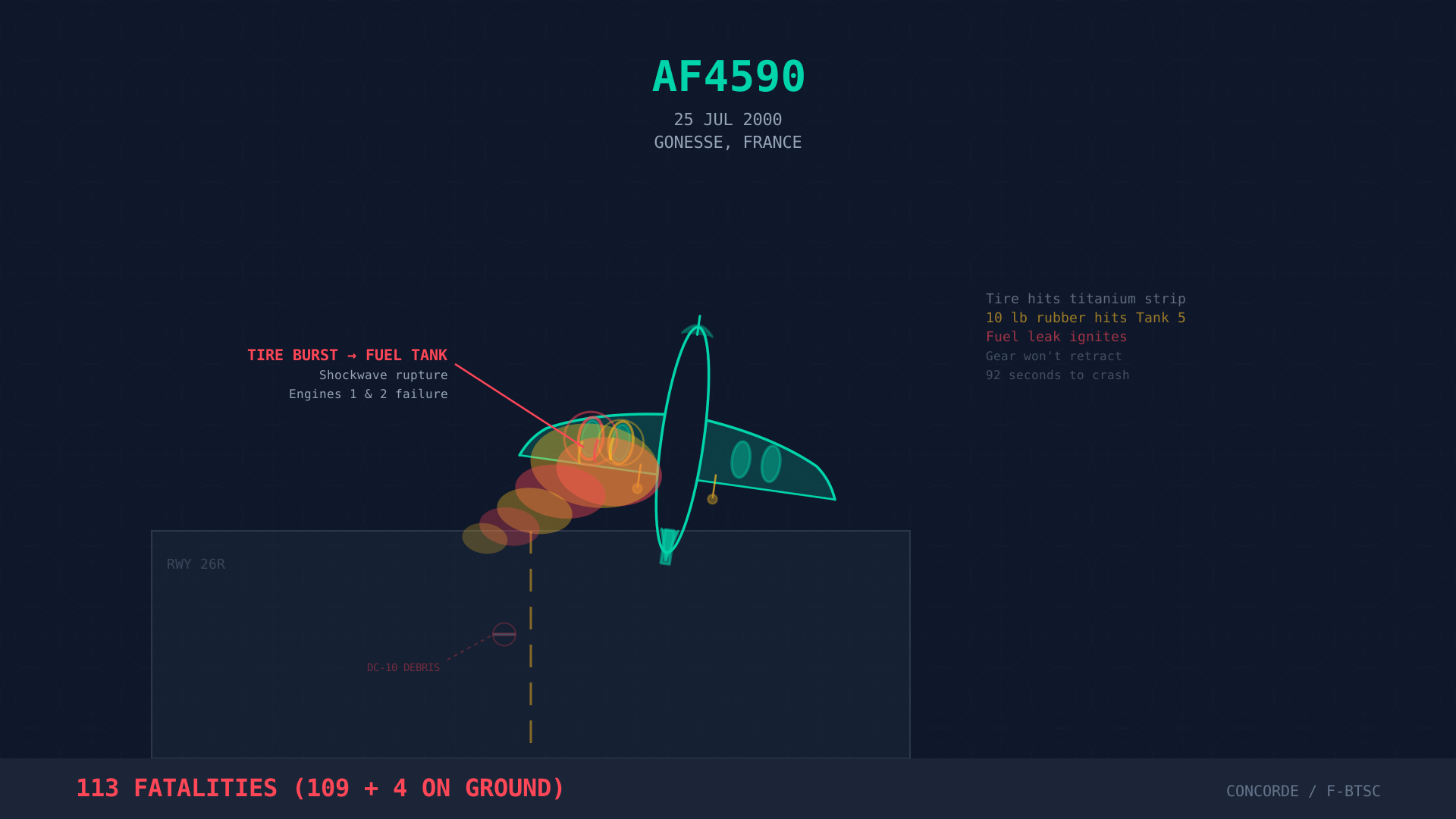
At 4:42 PM local time, traveling at 185 mph, the Concorde's right front tire struck a small strip of titanium alloy that had fallen from another aircraft minutes earlier. The tire exploded, sending a 10-pound chunk of rubber hurtling into the underside of the left wing at 140 meters per second.
The rubber didn't puncture the fuel tank. It didn't have to. The impact created a shockwave that ruptured Tank 5, the largest fuel tank, at its weakest point. Fuel gushed out at an estimated 60 liters per second and immediately ignited, creating a massive fire under the left wing.
Within seconds, the fire destroyed Engine 1 and severely damaged Engine 2. The Concorde, already past the point of no return on the runway, struggled into the air trailing fire. Captain Christian Marty fought desperately to control the aircraft, but with two engines failing and the landing gear unable to retract, the Concorde could not maintain flight.
One minute and thirty-two seconds after the tire burst, the aircraft crashed into a hotel in Gonesse, a suburb north of Paris. The impact and resulting fire killed all 109 people aboard and 4 people on the ground.
It was the only fatal accident in Concorde's 27-year history of passenger service—and it would mark the beginning of the end for the world's only successful supersonic passenger aircraft.
The Concorde
The Concorde was aviation's boldest gamble: a supersonic passenger jet capable of cruising at twice the speed of sound. Developed jointly by Britain and France in the 1960s, the Concorde entered service in 1976 and represented the pinnacle of aerospace engineering.
With its distinctive delta wing, needle nose, and four powerful afterburning turbojets, Concorde could fly from Paris to New York in under three and a half hours—half the time of subsonic jets. It cruised at Mach 2.04 (1,354 mph) at 60,000 feet, high enough to see the curvature of the Earth.
But Concorde was also expensive to operate, limited in range, and carried only 100 passengers. It served a niche market—wealthy business travelers and tourists who valued time over cost. By 2000, Air France and British Airways operated the world's remaining fleet of just 13 Concordes.
The aircraft on Flight 4590, registration F-BTSC, was 25 years old but had been maintained to the highest standards. It had logged over 11,000 flight hours. Like all Concordes, it had an exceptional safety record—no fatal accidents in a quarter-century of service.
The Flight
Air France Flight 4590 was a charter flight booked by a German tour company, Peter Deilmann Cruises. The 96 passengers—mostly middle-aged German tourists—were flying to New York to board the cruise ship MS Deutschland for a 16-day Caribbean cruise.
The passengers had paid premium prices for the Concorde experience. Many had never flown on the supersonic jet before and were excited for the journey. They boarded at Charles de Gaulle Airport Terminal 1, walking across the tarmac to the sleek white aircraft with its distinctive drooping nose.
The crew consisted of:
- Captain Christian Marty, 54, an experienced Concorde pilot with over 13,000 flight hours
- First Officer Jean Marcot, 50, also highly experienced on the Concorde
- Flight Engineer Gilles Jardinaud, 58, a veteran of the type
- Six flight attendants led by Chief Steward Christian Marty (no relation to the captain)
The flight was running late due to a minor technical delay. By the time the Concorde pushed back from the gate, it was 90 minutes behind schedule.
The Takeoff Roll
At 4:42 PM, Air France Flight 4590 was cleared for takeoff from Runway 26 Right. Captain Marty advanced the throttles, engaging the powerful Olympus 593 afterburning engines. The Concorde accelerated rapidly down the runway.
Unknown to the crew, 9 minutes earlier, Continental Airlines Flight 55—a DC-10 bound for Newark—had taken off from the same runway. During its takeoff roll, a 17-inch-long titanium alloy wear strip from the DC-10's thrust reverser had detached and fallen onto the runway.
This strip of metal—part of a repair that did not meet manufacturer specifications—lay on the runway directly in the Concorde's path.
At 4:42:31 PM, traveling at 185 mph during the takeoff roll, the Concorde's right front tire (tire number 2) struck the titanium strip. The impact was catastrophic for the tire, which was inflated to very high pressure to support the Concorde's weight and speed.
The tire burst immediately, sending a large chunk of rubber—estimated at 10 pounds—flying upward and backward at high velocity.
The Shockwave
At 4:42:31 PM, the chunk of tire struck the underside of the left wing near Tank 5, the Concorde's largest fuel tank. The impact did not penetrate the tank skin. But it didn't need to.
The impact created a hydrodynamic shockwave that propagated through the fuel inside the tank. This shockwave—a pressure pulse traveling at the speed of sound through the liquid—struck the upper skin of the tank from inside, rupturing it at its weakest point: the point where the tank was connected to the wing structure.
A 12-inch hole was torn in the top of Tank 5. Fuel began pouring out at an estimated 60 liters per second.
The leaking fuel immediately encountered an ignition source—most likely an electrical arc in the landing gear bay or contact with the hot engine—and ignited. A massive plume of fire erupted behind and below the left wing.
The Fire
The cockpit voice recorder captured the first indication of the problem at 4:42:31 PM:
Flight Engineer: "Failure engine number 2."
Two seconds later, the tower controller saw the fire:
Tower: "Concorde 4590, you have flames! You have flames behind you!"
The fire was enormous—witnesses described a flame trail extending 200 feet behind the aircraft. Engine 1, mounted closest to the fire, began to fail. Engine 2, also affected by the flames and debris, lost thrust.
Captain Marty faced an impossible situation. The Concorde had passed V1—the decision speed beyond which a takeoff cannot safely be aborted. The aircraft was accelerating through 190 mph with 2 of 4 engines failing and a massive fire underneath.
He had no choice but to try to get airborne.
The Desperate Struggle
At 4:42:54 PM—23 seconds after the tire burst—the Concorde lifted off the runway. But it was not a normal takeoff. The aircraft was struggling, barely climbing, trailing fire.
The landing gear would not retract—either damaged by the fire or unable to retract due to loss of hydraulic pressure. The extended gear created enormous drag. The fire continued to consume the underside of the wing.
Flight Engineer: "The airspeed!"
Captain Marty: "Watch the airspeed... the airspeed, the airspeed, the airspeed..."
The Concorde was barely maintaining flight. It climbed to just 200 feet above the ground, unable to accelerate, unable to gain altitude. The two damaged engines were producing minimal thrust. The extended landing gear and the asymmetric thrust were creating a near-uncontrollable situation.
First Officer Marcot attempted to retract the landing gear, but it would not come up.
At 4:43:13 PM, Engine 1 failed completely.
Captain Marty: "Too late... no time."
The Concorde, now flying on essentially two engines with massive drag and fire damage, could not maintain level flight. It began to descend.
The Crash
At 4:43:25 PM, the Concorde rolled sharply to the left and pitched nose-down. Captain Marty fought the controls, but the aircraft was no longer controllable.
At 4:44:31 PM—one minute and thirty-two seconds after the tire burst—the Concorde struck the Hôtelissimo, a small hotel in Gonesse, a suburb approximately 6 miles northeast of the airport.
The impact was catastrophic. Traveling at over 200 mph and at a steep angle, the Concorde obliterated the hotel and disintegrated. The fire that had been trailing the aircraft engulfed the wreckage. The fuel still aboard—thousands of pounds—ignited in a massive fireball visible for miles.
All 109 people aboard—100 passengers and 9 crew—died instantly.
Four people on the ground—employees of the hotel—also died in the impact and fire.
The Investigation
French accident investigators from the BEA (Bureau d'Enquêtes et d'Analyses) arrived on the scene within hours. What they found was total devastation—the hotel destroyed, the Concorde reduced to burnt wreckage, no survivors.
The investigation quickly identified key evidence:
The Metal Strip: Investigators found the titanium alloy strip on the runway. It was traced to Continental Airlines Flight 55. Examination showed it was a wear strip from the DC-10's thrust reverser that had been improperly installed during maintenance—held in place with wrong-sized spacers.
The Tire: Pieces of the burst tire were recovered from the runway. Examination showed the tire had struck the metal strip and burst from the impact.
Tank 5: The ruptured fuel tank showed characteristic damage from a high-velocity impact on the outside and a pressure wave rupture on the inside.
The Fire: Witness photographs and video clearly showed the massive fire trailing the aircraft from shortly after the tire burst.
The Chain of Events
Investigators reconstructed the accident sequence:
- The improperly installed titanium strip fell from Continental Flight 55 onto the runway
- Concorde's tire struck the strip and burst
- A 10-pound chunk of tire struck Tank 5 at 140 m/s
- The impact created a shockwave that ruptured the tank from inside
- Fuel poured out and ignited
- The fire damaged or destroyed Engines 1 and 2
- The landing gear could not retract (possibly due to fire damage or loss of hydraulics)
- The aircraft became uncontrollable and crashed
But the BEA also identified contributing factors:
Overweight: The aircraft was over its maximum structural weight by 810 kg (1,790 lb), loaded so the center of gravity was aft of the acceptable limit. This made the aircraft less controllable and more vulnerable to asymmetric thrust.
Tire Condition: The burst tire had been previously retreaded and was at the end of its service life.
Fuel Tank Design: The Concorde's fuel tanks were not designed to withstand this type of impact. Previous incidents of tire debris strikes had not resulted in tank rupture, but the BEA noted that the tanks were vulnerable.
Undercarriage Design: Some investigators questioned whether the landing gear arrangement made the Concorde particularly vulnerable to tire burst debris.
The Trial
In 2010, French authorities brought criminal charges against Continental Airlines and five individuals—Continental employees and officials from the French aviation authority—for involuntary manslaughter.
The trial focused on whether the improperly installed wear strip was the sole cause of the accident or whether Air France and the Concorde's designers bore some responsibility.
In 2010, the court found Continental Airlines and one of its mechanics guilty of involuntary manslaughter. Continental was fined and ordered to pay damages. The mechanic received a suspended sentence.
In 2012, an appeals court overturned these convictions, ruling that Continental could not be held criminally responsible. The court found that while the metal strip triggered the accident, the Concorde's design vulnerabilities were contributing factors.
The legal battles continued for years, with families of victims seeking accountability and compensation.
The End of Concorde
Air France and British Airways immediately grounded their Concorde fleets after the crash. For 15 months, the iconic aircraft sat silent while investigators worked and engineers developed modifications.
In 2001, Concordes returned to service with significant modifications:
- Kevlar lining in fuel tanks to prevent rupture
- Burst-resistant tires
- Enhanced electrical system protection
- Improved fire detection and suppression
But the damage to Concorde's reputation was done. Bookings plummeted. The aircraft was already operating at a financial loss, sustained only by its prestige value. After the crash, that prestige was tarnished.
On April 10, 2003, Air France and British Airways jointly announced that Concorde would be retired later that year. Rising maintenance costs, declining bookings, and the post-9/11 downturn in luxury travel made the aircraft economically unviable.
On October 24, 2003, British Airways flew the final commercial Concorde flight from New York to London. The era of supersonic passenger flight was over.
Legacy
Air France Flight 4590 demonstrated how a seemingly minor event—a piece of debris on a runway—can trigger a catastrophic chain reaction in a complex system.
The accident showed that even the most advanced aircraft have vulnerabilities. The Concorde's fuel tanks, designed for high-speed flight, were susceptible to damage from runway debris impacts that might not affect other aircraft.
It also highlighted the importance of proper maintenance. The improperly installed wear strip that fell from the Continental DC-10 was a direct maintenance failure—wrong parts used, improper installation, inadequate inspection.
The 113 victims—mostly German tourists excited for a Caribbean cruise, French crew members who had dedicated their careers to the Concorde, hotel employees simply working that day—died because of a confluence of factors that created a disaster from a chain of improbable events.
The Memorial
A memorial stands near the crash site in Gonesse, bearing the names of all 113 victims. Every July 25, families gather to remember.
The hotel that was destroyed was rebuilt. Life in Gonesse continued. But the memory of the day Concorde fell—the day fire engulfed the symbol of aviation's supersonic dream—remains.
The Dream of Speed
Concorde represented humanity's ambition to conquer distance through speed. For 27 years, it fulfilled that dream, carrying passengers across the Atlantic at twice the speed of sound, making the impossible routine.
Flight 4590 was Concorde's only fatal accident. In more than a quarter-century of service, millions of passengers had flown safely on the iconic aircraft.
But one catastrophic minute on a runway outside Paris ended it all.
Today, no supersonic passenger aircraft fly. The Concorde fleet sits in museums around the world, elegant reminders of an era when speed seemed worth any cost, when technology could shrink the world, when the wealthy could outrun the sun across the Atlantic.
The dream of supersonic passenger flight died in a hotel parking lot in Gonesse on July 25, 2000. Whether it will ever return remains to be seen.
But for the 113 people who died that day, there is no return. They boarded an aircraft that promised to deliver them safely to New York. They died in a fire that should never have happened, triggered by a chain of events that converged in the worst possible way.
Their memory lives on in the memorial at Gonesse, in the museums where Concordes rest, and in the history of an aircraft that flew too close to the edge—and finally fell.