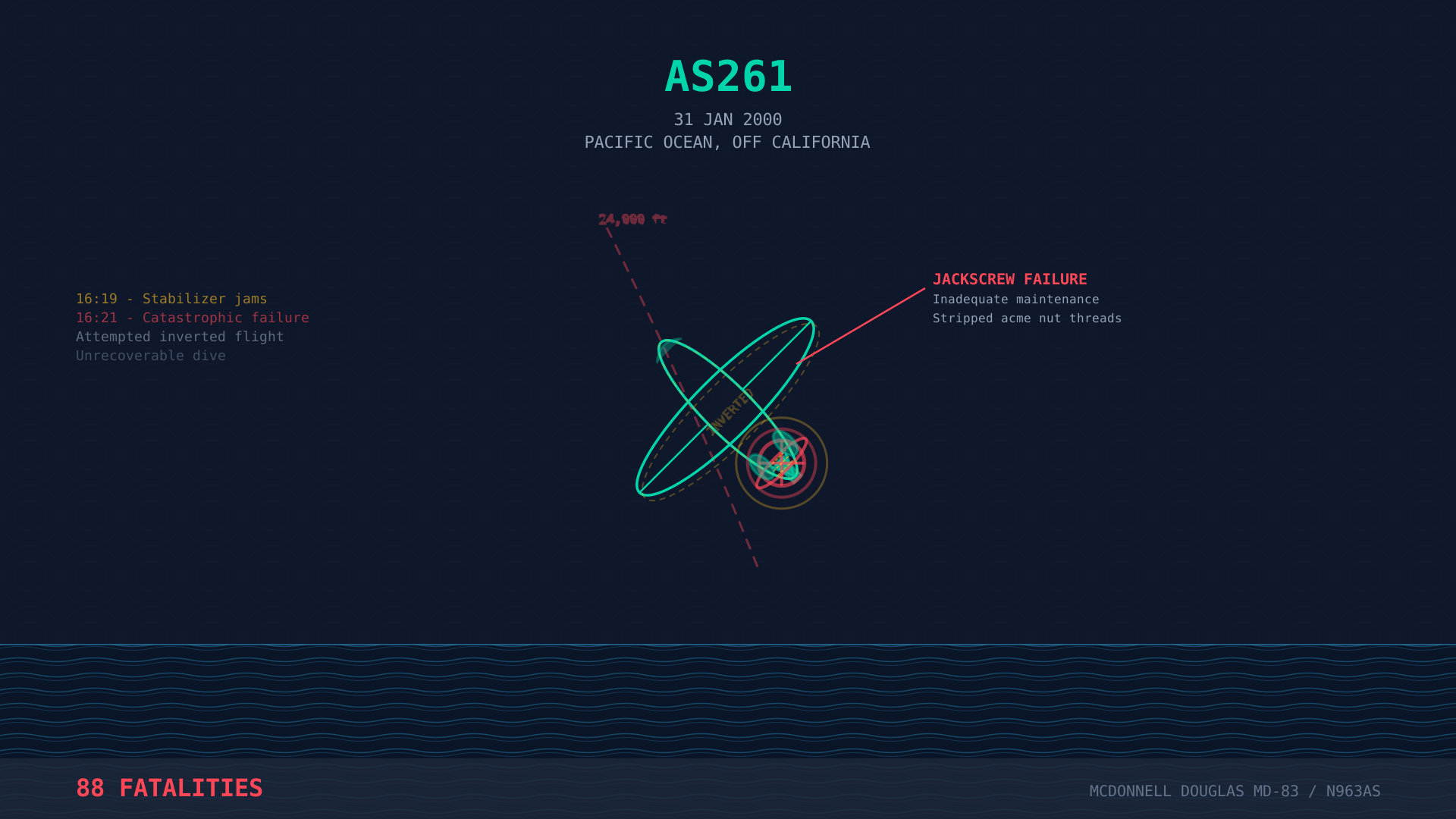
The Flight They Couldn't Save
On January 31, 2000, Alaska Airlines Flight 261 departed Puerto Vallarta, Mexico, bound for San Francisco and Seattle. The McDonnell Douglas MD-83 climbed smoothly to its cruising altitude, and for the first two hours, the flight proceeded normally.
Then, without warning, the horizontal stabilizer—the movable surface on the tail that controls the aircraft's pitch—jammed. What began as a controllable trim problem quickly escalated into a life-or-death struggle as the pilots discovered that the jackscrew mechanism that controlled the stabilizer had catastrophically failed.
For the next 20 minutes, Captain Ted Thompson and First Officer Bill Tansky fought to save their aircraft. They troubleshot the system, coordinated with maintenance, and tried emergency procedures. When nothing worked, they attempted something almost unthinkable: flying the aircraft upside down.
For a brief, extraordinary moment, they succeeded. The MD-83 flew inverted, under control, as the pilots desperately tried to reach an airport.
But the damaged jackscrew finally gave way completely. The horizontal stabilizer swung to its full nose-down position. The aircraft pitched forward into a steep dive from which there would be no recovery.
All 88 people aboard—83 passengers and 5 crew members—died when Flight 261 plunged into the Pacific Ocean off the coast of California.
The investigation would reveal that the crash was not an unavoidable mechanical failure, but the result of a maintenance program that had prioritized cost savings over safety, ignored warning signs, and allowed a critical component to wear beyond safe limits.
The Flight
Alaska Airlines Flight 261 departed Lic. Gustavo Díaz Ordaz International Airport in Puerto Vallarta at 1:37 PM Pacific Time on January 31, 2000. The aircraft was an MD-83, registration N963AS, a twin-engine jetliner commonly used for medium-range routes.
Captain Theodore "Ted" Thompson, 53, was at the controls. An experienced pilot with over 17,000 flight hours, Thompson had been flying for Alaska Airlines for more than a decade. First Officer William "Bill" Tansky, 57, sat in the right seat with over 8,000 flight hours. The cabin crew consisted of three flight attendants.
Among the 83 passengers were Alaska Airlines employees traveling on company passes, families returning from vacation, and business travelers. Two off-duty Alaska Airlines pilots—Captain Tom Stockley and First Officer Morris Thompson (no relation to Captain Thompson)—were seated in the cabin, heading home from vacation.
The flight plan called for a stop in San Francisco before continuing to Seattle. Weather was clear, and the flight departed on schedule.
The First Sign of Trouble
At 3:49 PM, as Flight 261 cruised at 31,000 feet along the California coast, Captain Thompson and First Officer Tansky noticed the horizontal stabilizer trim was moving on its own.
The horizontal stabilizer is a critical flight control surface. On the MD-80 series aircraft, it's a large movable section of the tail that tilts up or down to control the aircraft's pitch. The stabilizer's position is controlled by a jackscrew—a threaded rod and nut assembly powered by electric motors. Turning the jackscrew tilts the stabilizer, trimming the aircraft for level flight.
The trim on Flight 261 was moving toward the nose-down position without pilot input. The pilots countered by using the electric trim switches to move it back. It worked, but they were puzzled.
Over the next several minutes, the trim issue became more pronounced. The stabilizer kept trying to move to nose-down. The pilots repeatedly had to trim it back to maintain level flight.
At 4:09 PM, the problem escalated. The pilots heard unusual noises from the tail—thumps and grinding sounds. The trim system seemed to be binding or jamming.
"It's a lot worse than it was," First Officer Tansky said.
Captain Thompson agreed. They decided to troubleshoot using the aircraft's systems and to contact Alaska Airlines maintenance for guidance.
The Troubleshooting
At 4:10 PM, the pilots contacted Alaska Airlines maintenance via radio. They described the trim problem: the horizontal stabilizer was difficult to move, was making unusual noises, and seemed to be jamming.
The maintenance controller suggested several troubleshooting steps. The pilots tried cycling the trim using the electric trim switches. The stabilizer moved jerkily, accompanied by loud thumping sounds audible even in the cockpit.
Then, at 4:11 PM, the stabilizer jammed completely. The electric trim motors could no longer move it at all.
The pilots attempted to use the alternate trim system—a manual backup controlled by a wheel in the cockpit. But the jackscrew was so badly jammed that even the manual system couldn't budge it.
Flight 261 was now flying with the horizontal stabilizer frozen in position. The aircraft could still be controlled using the elevators—smaller control surfaces on the tail—but the pilots would have to manually fight the control forces. It was manageable, but it was not normal, and it was not safe.
Captain Thompson made the decision to divert. They were approaching the Los Angeles area. They would land at Los Angeles International Airport (LAX), the nearest major airport with maintenance facilities.
At 4:17 PM, they declared an emergency and requested vectors to LAX.
The Catastrophic Failure
For the next few minutes, the pilots worked to stabilize their situation. The aircraft was controllable, if difficult to fly. They began descending toward LAX, coordinating with air traffic control and briefing the cabin crew.
Then, at 4:19 PM, everything changed.
The horizontal stabilizer, which had been jammed for eight minutes, suddenly broke free. But instead of returning to a normal position, it swung violently to its full nose-down limit—a catastrophic uncommanded movement.
The aircraft pitched nose-down sharply. Despite pulling back hard on the control columns, the pilots could not counter the stabilizer's nose-down force. Flight 261 began diving.
"Mayday!" Captain Thompson called. But there was no time to explain. The aircraft was accelerating downward, gaining speed rapidly.
The jackscrew threads had failed completely. The acme nut that rode on the jackscrew threads had worn so thin that the threads had stripped away. Without the threads to hold it in position, the stabilizer was free to swing to whatever position aerodynamic forces pushed it—and those forces pushed it nose-down.
Flying Inverted
As the aircraft dove, the pilots fought desperately to regain control. They pulled back on the control columns with all their strength. They reduced engine power. Nothing worked.
At 4:20 PM, descending through 23,000 feet at high speed, Captain Thompson made an extraordinary decision. If they couldn't control the aircraft right-side up with the stabilizer jammed nose-down, perhaps they could control it upside down, where the aerodynamics would be reversed.
"Let's try it inverted," Thompson said.
It was a maneuver no commercial airliner pilot is trained to perform. But Captain Thompson and First Officer Tansky were out of options.
They rolled the aircraft inverted. The MD-83 flew upside down, with the passengers and cabin crew hanging from their seatbelts, the ocean visible through the windows above their heads.
And remarkably, it worked—for a moment.
With the aircraft inverted, the nose-down stabilizer position became effectively nose-up. The pilots could maintain controlled flight. They held the aircraft steady, inverted, at about 24,000 feet.
For perhaps a minute, the desperate gambit seemed like it might succeed. The pilots discussed whether they could fly the aircraft inverted all the way to an airport and somehow land it.
But the structural and aerodynamic forces on an inverted airliner are immense. The flight controls were reversed. The engines were upside down. Fuel system complications began to emerge. And most critically, the jackscrew—now subject to reversed loads—was still damaged.
At 4:21 PM, the jackscrew failed completely. The horizontal stabilizer swung even further to its nose-down limit. Even inverted, the aircraft could no longer be controlled.
The Final Plunge
Flight 261 rolled back to an upright position and pitched nose-down into a steep dive. This time, there was no recovery.
The aircraft accelerated downward, exceeding 300 knots, then 400 knots. The pilots pulled on the controls, but the damaged horizontal stabilizer created forces they could not overcome.
At 4:22 PM, Alaska Airlines Flight 261 struck the Pacific Ocean at high speed approximately 2.7 miles north of Anacapa Island, off the coast of Ventura County, California.
The impact was catastrophic. The aircraft disintegrated instantly. The force of the impact was so great that it created a debris field covering several square miles of ocean floor in 650 feet of water.
All 88 people aboard died on impact.
The Investigation
The National Transportation Safety Board launched an immediate investigation. Coast Guard and Navy vessels began searching for wreckage and recovering victims. Because the aircraft had crashed in relatively deep water far from shore, the recovery operation was complex and dangerous.
Over the following weeks, divers and remotely operated vehicles recovered critical wreckage, including the horizontal stabilizer jackscrew assembly—the key to understanding what had happened.
What they found was shocking.
The acme nut—the component that rides on the jackscrew threads and converts rotation into linear motion—was almost completely worn through. The threads inside the nut had worn down so much that only minimal thread engagement remained. When the threads finally stripped away, the nut could no longer hold the stabilizer in position.
Further examination revealed the cause of the wear: inadequate lubrication. The jackscrew assembly requires regular lubrication to prevent metal-on-metal friction from wearing down the threads. But investigators found almost no lubricant on the jackscrew recovered from Flight 261.
The NTSB turned its attention to Alaska Airlines' maintenance program.
The Maintenance Failures
What the investigation uncovered was a systematic failure of maintenance oversight that had been building for years.
Extended Maintenance Intervals: Alaska Airlines had progressively extended the time between jackscrew inspections and lubrications, far beyond McDonnell Douglas' original recommendations. The manufacturer recommended lubrication every 900-1,200 flight hours. Alaska Airlines had extended the interval to every 2,550 flight hours, and in some cases even longer. The FAA had approved these extensions based on Alaska's assurances that the extensions were safe.
Inadequate Lubrication: Even when maintenance was performed, the lubrication procedures used by Alaska Airlines were often inadequate. Mechanics sometimes did not apply enough grease, or did not verify that the grease had penetrated into the thread contact areas.
Missed Inspections: Some required inspections had been deferred or skipped entirely. Records showed that the jackscrew on N963AS had not been properly inspected in years.
Warning Signs Ignored: Alaska Airlines had experienced previous jackscrew problems on other aircraft. Maintenance records documented jackscrews found with excessive wear, out-of-limits measurements, and inadequate lubrication. Yet the airline did not shorten inspection intervals or mandate more thorough inspections across the fleet.
Culture of Cost-Cutting: Investigators found evidence that Alaska Airlines' maintenance culture prioritized cost reduction and schedule reliability over safety. Mechanics faced pressure to minimize maintenance time and costs. Warning signs about jackscrew wear were not escalated or addressed systematically.
The NTSB concluded that the jackscrew failure was the direct result of Alaska Airlines' inadequate maintenance program, and that the FAA had failed to adequately oversee the airline's maintenance interval extensions.
The Pilots' Heroism
While the investigation identified systemic maintenance failures, it also revealed the extraordinary efforts of Captain Thompson and First Officer Tansky to save their aircraft and passengers.
Voice recorder analysis showed that the pilots worked calmly and professionally throughout the crisis. They systematically troubleshot the problem, coordinated with maintenance, declared an emergency appropriately, and prepared for an emergency landing.
When the stabilizer failed catastrophically, they did not panic. They fought to regain control, attempting extreme maneuvers—including inverted flight—that no commercial pilot is trained to perform.
The off-duty pilots in the cabin, Captain Stockley and First Officer Morris Thompson, came forward to offer help. The cockpit crew accepted, using all available resources—textbook crew resource management under the most extreme circumstances.
The NTSB concluded that the pilots' actions were exemplary and that no pilot action or inaction contributed to the accident. The aircraft was simply not controllable once the jackscrew failed.
In the words of NTSB Chairman Jim Hall: "These pilots did everything they could, and more than anyone should ever have to do, to try to save that airplane."
Safety Changes
Alaska Airlines Flight 261 led to sweeping changes in maintenance oversight and jackscrew inspection requirements:
Jackscrew Inspections: The FAA mandated immediate inspections of horizontal stabilizer jackscrews on all MD-80 series aircraft. Airlines found numerous jackscrews with excessive wear, validating concerns about inadequate maintenance.
Lubrication Requirements: New requirements specified detailed lubrication procedures, amounts, and verification checks. Maintenance personnel must now document that adequate lubrication has been applied and has penetrated the thread contact areas.
Inspection Intervals: The FAA reversed many of Alaska Airlines' extended maintenance intervals, returning to shorter intervals closer to manufacturer recommendations. Airlines can no longer unilaterally extend critical inspection intervals without rigorous justification and FAA oversight.
Maintenance Culture: The accident highlighted the dangers of cost-driven maintenance cultures. The FAA enhanced oversight of airline maintenance programs, looking not just at technical compliance but at the underlying safety culture.
Design Changes: While not directly mandated, some operators installed jackscrew monitoring systems that provide real-time indication of jackscrew condition and wear.
Alaska Airlines Overhaul: Alaska Airlines undertook a comprehensive review and overhaul of its maintenance program. The airline accepted responsibility for the accident and implemented extensive changes to prevent a recurrence.
The Families and the Memorial
For the families of the 88 victims, the revelation that inadequate maintenance had caused the crash was devastating. Many felt betrayed by an airline they had trusted, by a maintenance system that had failed, and by regulators who had not provided adequate oversight.
Alaska Airlines faced multiple lawsuits from victims' families. The airline ultimately reached settlements and accepted responsibility for the accident.
In 2003, a memorial was dedicated at Port Hueneme, California, near where Flight 261 crashed. The memorial features a sundial and a curved granite wall inscribed with the names of all 88 victims. It overlooks the Pacific Ocean, providing a place for families to remember and reflect.
The memorial's dedication plaque includes a quote chosen by the families: "They shall mount up with wings as eagles."
The Unanswerable Questions
One question haunts the Flight 261 story: how many times had Alaska Airlines aircraft flown with jackscrews in similarly dangerous condition?
The post-accident inspections found numerous other Alaska Airlines aircraft with jackscrews showing excessive wear, inadequate lubrication, or out-of-limits measurements. How many flights had operated just one worn thread away from catastrophic failure?
Investigators concluded that Flight 261 was not an isolated case of a single component failure, but rather the inevitable result of a maintenance program that had, for years, allowed critical components to degrade beyond safe limits.
The fact that it took a catastrophic accident to reveal these systemic problems remains a source of anguish for regulators, industry professionals, and most of all, for the families of the victims.
Legacy
Alaska Airlines Flight 261 demonstrated that even the most capable pilots cannot save an aircraft when a critical system fails catastrophically. Captain Thompson and First Officer Tansky did everything possible—and more than should ever be asked—but the aircraft was simply not controllable.
The accident proved that maintenance is not a cost center to be minimized, but a safety imperative that must be vigilantly maintained. Extending inspection intervals, deferring maintenance, and prioritizing cost over thoroughness creates risks that can be invisible until they become catastrophic.
The 88 victims of Flight 261 died because a maintenance program failed to adequately care for a critical component. Their deaths led to fundamental changes in how maintenance is performed, documented, and overseen across the aviation industry.
Every jackscrew inspection performed today, every lubrication procedure verified, every maintenance interval scrutinized, honors the memory of those 88 people and ensures that their deaths were not in vain.
Remembering the 88
The memorial at Port Hueneme stands as a permanent reminder of the 88 lives lost on January 31, 2000. Each name represents a person—a story, a family, a future that ended in the Pacific Ocean.
There were children on the flight, traveling with their families. Adults heading home from vacation. Alaska Airlines employees who had dedicated their careers to the company that failed them. Off-duty pilots who had spent their lives keeping people safe, powerless to save themselves when their own aircraft failed.
Captain Thompson and First Officer Tansky fought to the very end to save their passengers. The cabin crew maintained professionalism even as their world turned literally upside down. The passengers trusted that their aircraft was safe, that the maintenance had been done properly, that the systems would work.
That trust was betrayed by a corporate culture that had allowed cost considerations to override safety imperatives.
The legacy of Alaska Airlines Flight 261 is not just the technical changes to jackscrew maintenance, but the reminder that in aviation, there is no acceptable tradeoff between safety and cost. Every maintenance procedure exists for a reason. Every inspection interval is calculated based on engineering analysis. Every component must be maintained to the highest standards, every time, without exception.
When those standards slip—when inspections are deferred, when maintenance intervals are stretched, when warning signs are ignored—people die.
The 88 victims of Flight 261 paid the price for those failures. Their memory demands that the lessons be remembered, the standards be maintained, and the vigilance never waver.
The Pacific Ocean continues its endless rhythm off the coast of California. The memorial stands watch, the names carved in stone, a permanent reminder that safety is not negotiable, that maintenance matters, and that 88 people who should have arrived safely in San Francisco and Seattle instead rest beneath the waves.
May their memory be a blessing, and may their legacy be a safer sky for all who follow.