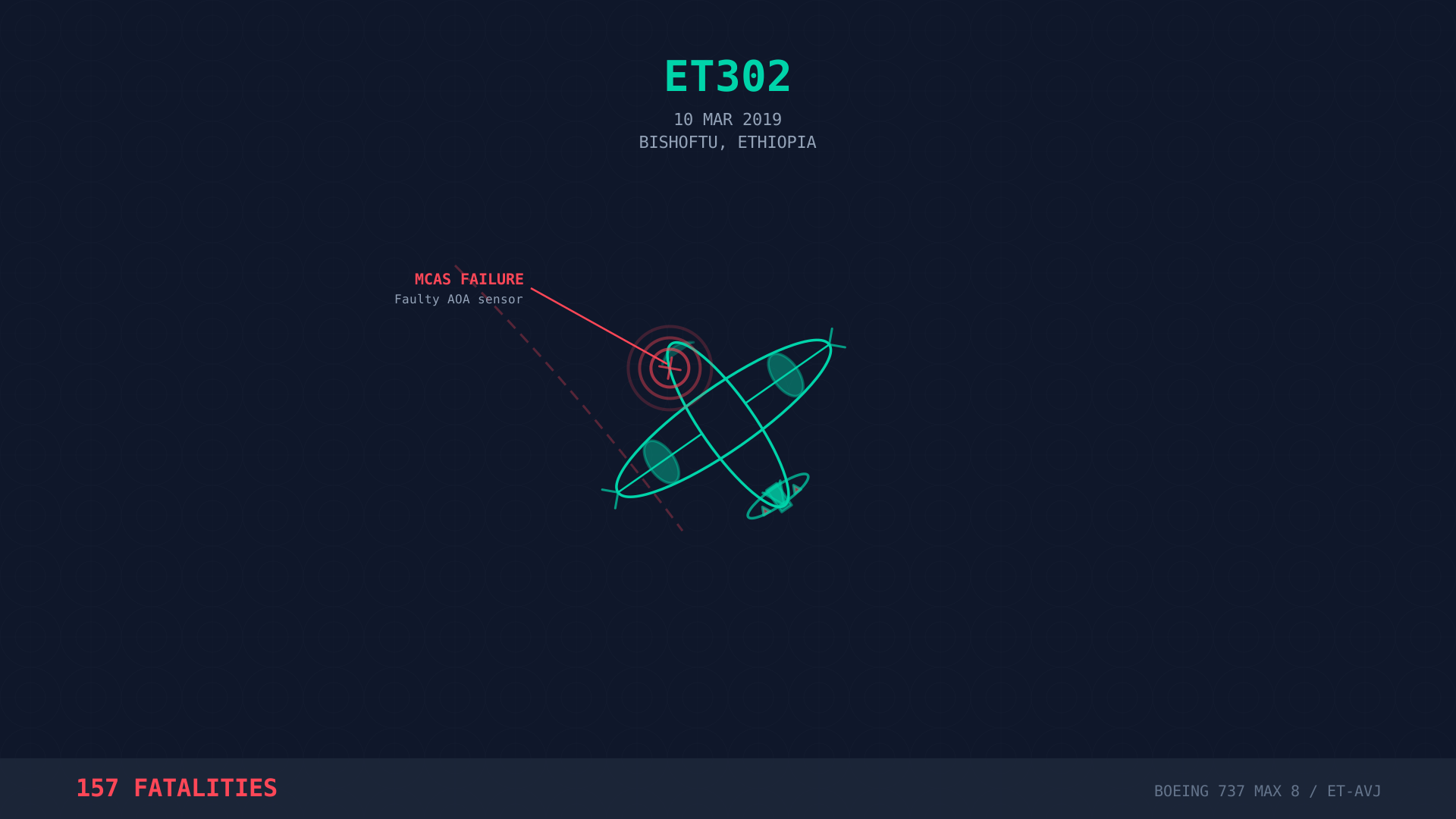
The Crash That Grounded an Icon
On March 10, 2019, Ethiopian Airlines Flight 302 crashed near the town of Bishoftu, Ethiopia, just six minutes after takeoff from Addis Ababa. All 157 people on board—149 passengers and 8 crew members—perished. The accident, involving Boeing's newest and most advanced narrow-body aircraft, the 737 MAX 8, triggered the most significant aviation crisis in decades and led to the worldwide grounding of all 387 Boeing 737 MAX aircraft.
A Routine International Flight
Flight 302 was scheduled to fly from Bole International Airport in Addis Ababa to Jomo Kenyatta International Airport in Nairobi, Kenya—a routine one-hour regional flight. The aircraft, registration ET-AVJ, was nearly brand new, having been delivered to Ethiopian Airlines just four months earlier in November 2018.
Captain Yared Getachew, 29, and First Officer Ahmednur Mohammed, 25, were at the controls. Despite their relatively young ages, both pilots were qualified and current on the 737 MAX. The passenger manifest reflected the international nature of the flight, with citizens from 35 different countries aboard, including UN staff, aid workers, tourists, and business travelers.
Six Minutes to Catastrophe
At 8:38 AM local time, Flight 302 took off from Runway 07R and began its climb toward Nairobi. Almost immediately, problems began.
Shortly after liftoff, the left angle-of-attack (AOA) sensor began providing erroneous data to the aircraft's flight control computers. This sensor measures the angle between the oncoming air and the aircraft's wing—critical information for preventing stalls.
At approximately two minutes into the flight, when the pilots retracted the flaps and engaged the autopilot as part of the normal climb procedure, the faulty sensor triggered the Maneuvering Characteristics Augmentation System (MCAS)—a new automated system designed specifically for the 737 MAX.
The MCAS Problem
The MCAS was Boeing's solution to a handling characteristic unique to the 737 MAX. The MAX's larger, more fuel-efficient engines were mounted slightly forward and higher on the wings compared to earlier 737 models. This engine placement could cause the nose to pitch up more aggressively during certain flight conditions.
MCAS was designed to automatically push the nose down if it detected an excessive angle of attack, making the MAX handle more like previous 737 variants. However, the system had a critical flaw: it relied on data from only a single AOA sensor. If that sensor failed or provided incorrect data, MCAS would activate when it shouldn't.
On Flight 302, the erroneous AOA reading caused MCAS to activate repeatedly, pushing the aircraft's nose down. The pilots fought the system, manually trimming the nose up each time MCAS pushed it down. The cockpit voice recorder captured their struggle as they tried to diagnose and overcome the problem.
Desperate Measures
Recognizing they were experiencing a runaway trim situation similar to the recent crash of Lion Air Flight 610 (which had killed 189 people just five months earlier), First Officer Mohammed called out "Stab trim cut-out!"—the emergency procedure to disable the electric trim system, including MCAS.
The pilots threw the stabilizer trim cutout switches, successfully deactivating MCAS. For a brief moment, it seemed they might regain control. However, they faced another problem: because MCAS had already pushed the nose so far down, the control forces required to manually trim the aircraft back to level flight were enormous.
At the aircraft's high speed—the pilots had not reduced throttle sufficiently after takeoff—aerodynamic forces on the stabilizer made it nearly impossible to manually crank the trim wheel. The pilots found themselves in an impossible situation: with electric trim disabled, they couldn't fight MCAS, but they also couldn't manually overcome the extreme nose-down position MCAS had created.
In desperation, they re-engaged the electric trim system, hoping to quickly adjust the stabilizer position. MCAS immediately reactivated and pushed the nose down again. The pilots had run out of options.
Impact and Aftermath
At 8:44 AM, just six minutes after takeoff, Flight 302 impacted the ground at high speed near Bishoftu in a nose-down attitude. The force of the impact was so severe that the aircraft disintegrated, creating a crater and scattering debris over a wide area. All 157 people aboard died instantly.
The accident scene was devastating. The aircraft had struck the ground with such force that identification of victims and recovery of remains proved extremely difficult. Many families never received complete remains of their loved ones.
The Global Response
The crash of Flight 302, occurring just months after the similar Lion Air crash, triggered immediate alarm throughout the aviation world. The similarities were undeniable: both were 737 MAX aircraft, both crashed shortly after takeoff, both involved MCAS activation due to faulty AOA sensors, and both pilots had struggled unsuccessfully to overcome the system.
Within days of the Ethiopian crash:
- March 11: China grounded all 737 MAX aircraft
- March 12: Ethiopia, Indonesia, and numerous other countries followed
- March 13: The European Union grounded the MAX
- March 13: The United States FAA, initially resistant, finally grounded all 737 MAX aircraft
By March 18, 2019, every single Boeing 737 MAX in the world—387 aircraft total—had been grounded. This affected 59 airlines across the globe and cancelled 8,600 weekly flights. The grounding would last 20 months, the longest in modern aviation history.
Investigation Findings
Multiple investigations—by Ethiopian authorities, the U.S. NTSB, and other agencies—identified several critical failures:
Design Flaws
- MCAS relied on a single AOA sensor with no redundancy
- The system was more powerful than pilots were led to believe, capable of moving the horizontal stabilizer to its full travel limit
- MCAS could repeatedly activate, not just once as Boeing had indicated
- Manual trim procedures were inadequate at high speeds
Training Deficiencies
- Pilots received minimal information about MCAS, with many unaware of its existence
- Boeing and regulators allowed pilots to transition to the MAX with only iPad-based training, not simulator time
- Emergency procedures were inadequate and in some scenarios, impossible to execute
Certification Failures
- The FAA had delegated significant portions of the MAX certification to Boeing itself
- Safety analyses underestimated the consequences of MCAS malfunctions
- The relationship between Boeing and regulators had become too cozy
Systemic Reforms
The 737 MAX disasters prompted the most significant overhaul of aircraft certification processes in decades:
MCAS Redesign: Boeing completely redesigned MCAS to:
- Use inputs from both AOA sensors, not just one
- Limit how many times it can activate
- Limit how far it can move the stabilizer
- Allow pilot inputs to override the system more easily
Enhanced Training: All 737 MAX pilots now receive comprehensive training on MCAS, including simulator time specifically addressing MCAS-related scenarios.
Certification Reform: The FAA and international regulators reformed the certification process to reduce reliance on manufacturer self-assessment and increase independent oversight.
Cultural Change: The accidents forced a reckoning about the pressure to meet production schedules and the balance between automation and pilot authority.
Boeing's Reckoning
The MAX crisis became the worst in Boeing's 103-year history. Beyond the grounding costs (estimated at over $20 billion), Boeing faced:
- Criminal charges (the company paid $2.5 billion to settle charges of defrauding the FAA)
- Hundreds of lawsuits from victims' families
- Congressional investigations
- The resignation of CEO Dennis Muilenburg
- Massive reputational damage
- Criminal charges against two senior Boeing employees
Return to Service
After redesign, extensive testing, and re-certification, the 737 MAX began returning to service in late 2020. However, the aircraft remains controversial, with some passengers specifically avoiding MAX flights and several airlines facing continued public skepticism.
Legacy
Ethiopian Airlines Flight 302 exposed how competitive pressure, cost-cutting, and regulatory capture could compromise safety even at the world's most respected aircraft manufacturer. The 157 victims—including entire families, UN workers, and young professionals—paid the ultimate price for systemic failures.
Their legacy is a transformed approach to aviation safety that rejects complacency and demands that profits never take precedence over human lives. The accident serves as a sobering reminder that even in the 21st century, with all our technological sophistication, fundamental principles of safety engineering, transparent regulation, and respect for pilot expertise remain essential.
The families of Flight 302's victims have become advocates for aviation safety, ensuring that their loved ones did not die in vain. Their voices helped drive the reforms that have made the aviation system safer and more accountable.