The Unthinkable Act
On March 24, 2015, Germanwings Flight 9525 departed Barcelona, Spain, bound for Düsseldorf, Germany. It was a routine flight on a clear morning, operated by an experienced crew in a well-maintained aircraft.
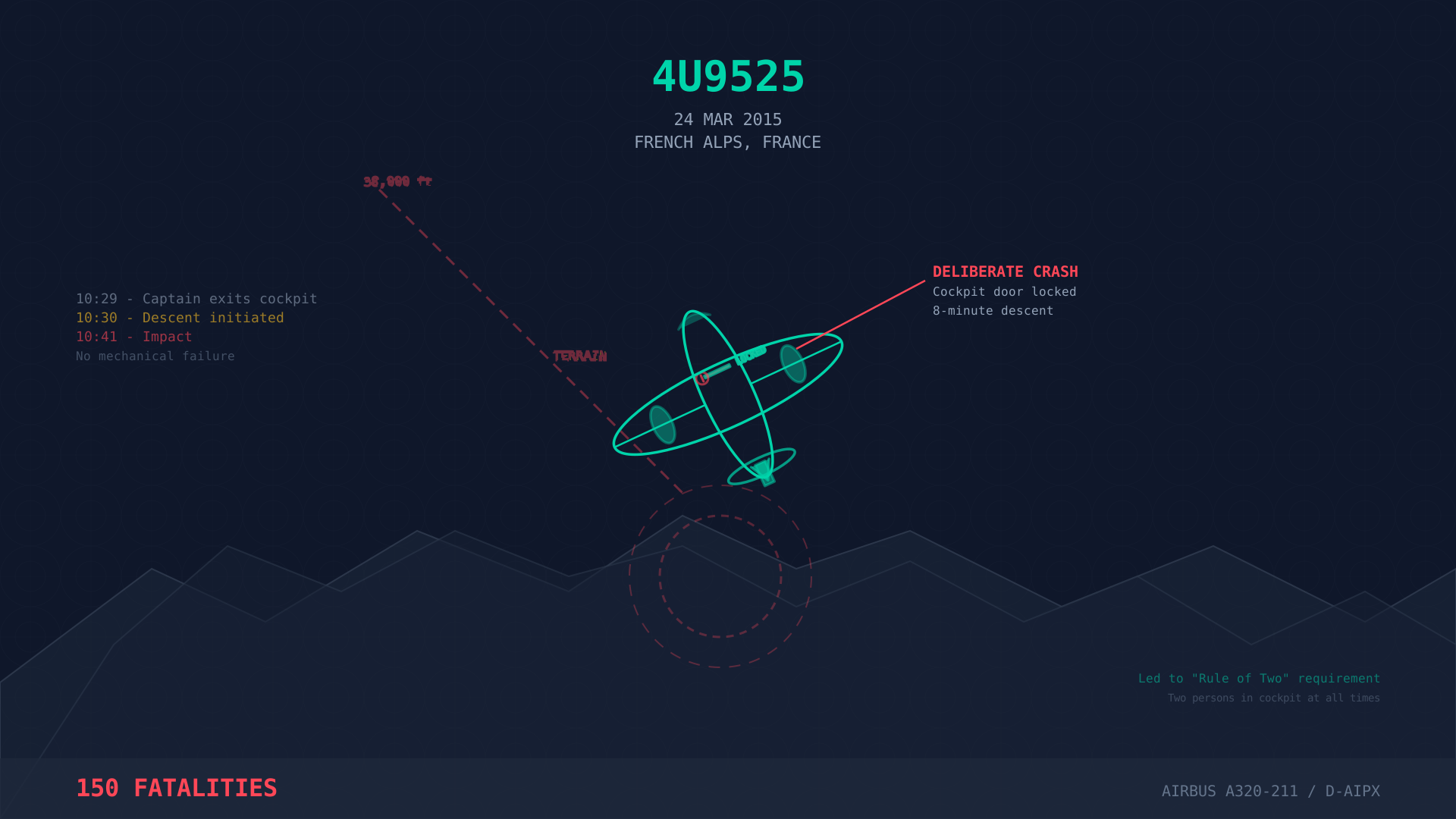
Twenty-three minutes into the flight, as the Airbus A320 cruised over southern France, the captain left the cockpit for a brief break. It was a normal occurrence on flights—pilots routinely step out to use the lavatory or stretch.
But when the captain tried to return, he found the cockpit door locked from inside. His co-pilot, 27-year-old Andreas Lubitz, had deliberately locked him out.
Over the next eight minutes, Lubitz methodically reprogrammed the autopilot to descend the aircraft into the French Alps. The captain pounded on the door, trying desperately to get back in. Passengers and flight attendants tried to break through. Air traffic controllers called repeatedly, getting no response.
At 10:41 AM Central European Time, Germanwings Flight 9525 struck a mountainside at high speed. The aircraft disintegrated on impact. All 150 people aboard—144 passengers, 5 cabin crew members, and the 2 pilots—died instantly.
The investigation would reveal that Andreas Lubitz had a history of severe mental health issues, including suicidal ideation, that had been concealed from his employer. His deliberate act of mass murder exposed critical gaps in pilot mental health oversight and forever changed how airlines monitor and support their flight crews.
The Flight
Germanwings Flight 4U9525 (marketed as 9525) departed Barcelona-El Prat Airport at 10:01 AM CET on March 24, 2015, bound for Düsseldorf Airport in Germany. The aircraft was an Airbus A320-211, registration D-AIPX, operated by Germanwings, a low-cost subsidiary of Lufthansa.
Captain Patrick Sondenheimer, 34, commanded the flight. An experienced pilot with over 6,000 flight hours, Sondenheimer had been with Lufthansa and Germanwings for over a decade. First Officer Andreas Lubitz, 27, sat in the right seat. Lubitz had joined Germanwings in 2013 and had approximately 630 flight hours.
The 144 passengers included German families returning from vacation in Spain, Spanish students on a school exchange program, and business travelers. Among them were 16 students and 2 teachers from Joseph-König-Gymnasium, a high school in Haltern am See, Germany.
The flight proceeded normally through departure and climb. Weather was excellent—clear skies, light winds, no turbulence. The crew communicated routinely with air traffic control as they climbed to their assigned cruising altitude of 38,000 feet.
At 10:27 AM, the aircraft reached cruising altitude and the autopilot was engaged. Everything appeared completely normal.
The Captain Leaves
At 10:29 AM, Captain Sondenheimer told First Officer Lubitz that he was stepping out of the cockpit. This was standard procedure—pilots often take brief breaks during cruise flight, and the autopilot maintains the aircraft on course.
The cockpit voice recorder captured Sondenheimer's departure. The sound of the cockpit door opening, the captain's footsteps, the door closing. Normal sounds on what should have been a normal flight.
Andreas Lubitz was now alone in the cockpit.
At 10:30 AM, Lubitz reached forward and twisted the autopilot altitude selector. Instead of the assigned 38,000 feet, he selected 100 feet—the minimum altitude the autopilot would accept. He pressed the button to engage the descent.
The Airbus A320 began descending.
The Descent
Marseille air traffic control noticed immediately that Flight 9525 was descending without clearance.
"Germanwings 9525, Marseille. You are descending. Is everything okay?"
No response.
Controllers called again. And again. No response.
The aircraft continued descending at a steady rate—approximately 3,500 feet per minute. Not the rapid emergency descent that would indicate a pressurization loss or mechanical emergency, but a controlled, deliberate descent.
Outside the cockpit, Captain Sondenheimer realized something was wrong. He knocked on the cockpit door. The door, designed to prevent unauthorized entry after 9/11, was locked from inside.
Sondenheimer knocked again, harder. He called to Lubitz through the door. He entered the emergency unlock code on the keypad outside the door.
But the door remained locked.
After the September 11 attacks, aircraft manufacturers had installed reinforced cockpit doors with sophisticated locking mechanisms. These doors can only be opened from outside if the person inside authorizes it—or if the person inside does not respond within 30 seconds to an emergency unlock code.
Lubitz, sitting at the controls, simply pressed the "LOCK" override button. The door would not open, no matter what code was entered from outside.
The Final Minutes
The cockpit voice recorder captured the sounds of increasing desperation outside the cockpit door.
Captain Sondenheimer pounding on the door. Calling to Lubitz. Shouting. The sounds grew more urgent as the aircraft descended lower and lower.
Passengers began to realize something was wrong. Some called loved ones. Some prayed. Some cried. The cabin crew tried to help the captain break through the reinforced door, but it was designed to withstand exactly this kind of force.
Air traffic controllers watched on their screens as Flight 9525 descended relentlessly toward the mountains. They cleared all other aircraft from the area and alerted emergency services, though they had no idea what was wrong or whether the crew was incapacitated.
Inside the cockpit, the voice recorder captured Andreas Lubitz's breathing—calm, steady, deliberate. He made no radio calls, spoke no words, responded to no warnings. The aircraft's ground proximity warning system activated: "TERRAIN! PULL UP! TERRAIN! PULL UP!"
Lubitz made no attempt to pull up. Instead, he appears to have increased the descent rate in the final moments.
At 10:40 AM, radar controllers saw Flight 9525's transponder signal disappear as the aircraft descended below the mountain peaks.
At 10:41:06 AM, the aircraft struck a mountainside near the village of Prads-Haute-Bléone in the French Alps at an altitude of approximately 6,550 feet. The impact speed was estimated at over 400 knots.
The Airbus A320 disintegrated instantly. Wreckage scattered across a steep, remote mountainside. The largest piece of wreckage found was no bigger than a small car.
All 150 people aboard died on impact.
The Recovery
The crash site was in extremely difficult terrain—a steep, rocky mountainside accessible only by helicopter or by foot. French emergency services, including mountain rescue teams and military personnel, were deployed immediately.
When they reached the site, they found total devastation. The aircraft had been completely destroyed by the impact. There were no survivors, no intact remains, no recognizable pieces of the aircraft structure.
Recovery teams worked for weeks in harsh conditions to recover human remains and aircraft wreckage. Every piece of debris had to be catalogued, photographed, and transported down the mountain by helicopter.
Critically, searchers recovered both flight recorders: the flight data recorder and the cockpit voice recorder. These black boxes would prove essential to understanding what had happened.
The Investigation
The French Bureau d'Enquêtes et d'Analyses (BEA), with assistance from German and international authorities, began investigating immediately.
The flight data recorder showed that the aircraft had functioned normally throughout the flight. All systems were operating correctly. The engines were producing power. The flight controls were responding normally. There was no mechanical failure, no system malfunction, no emergency condition.
The autopilot had been programmed to descend to 100 feet. The aircraft did exactly what it was commanded to do.
The cockpit voice recorder told the rest of the story: Captain Sondenheimer leaving the cockpit, the sound of the autopilot altitude selector being changed, the captain's increasingly desperate attempts to re-enter, and throughout it all, the sound of Andreas Lubitz breathing calmly as he flew the aircraft into the mountain.
The investigation turned to Lubitz himself. Who was he? What could explain this unthinkable act?
Andreas Lubitz
What investigators discovered was deeply troubling.
Andreas Lubitz had dreamed of being a pilot since childhood. He joined Lufthansa's flight training program in 2008. But in 2009, during training, he suffered a severe depressive episode and was temporarily removed from the program. He received psychological treatment and was eventually cleared to resume training.
Lufthansa's medical department was aware of his mental health history but cleared him to fly after receiving assurances from his doctors that he was fit for duty.
In the months before the crash, Lubitz's mental health had deteriorated again. He visited multiple doctors, complaining of vision problems and anxiety. Several physicians diagnosed him with severe depression and suicidal ideation. One doctor explicitly noted concerns about Lubitz's fitness to fly.
But under German medical privacy laws, these doctors could not inform Lufthansa without Lubitz's consent. And Lubitz did not give consent.
Investigators found that Lubitz had been declared unfit for work by doctors multiple times in the weeks before the crash. He had been given sick notes excusing him from duty. But he concealed these notes from his employer and continued to fly.
On the morning of March 24, 2015, Andreas Lubitz reported for duty despite having been declared medically unfit. He flew the first leg from Düsseldorf to Barcelona without incident. Then he boarded Flight 9525 for the return trip.
Investigators found evidence of internet searches on Lubitz's personal devices in the days before the crash. He had researched cockpit door security systems, suicide methods, and previous aircraft crashes.
The conclusion was inescapable: Andreas Lubitz had deliberately crashed Flight 9525, killing himself and 149 innocent people.
The Questions
The Germanwings disaster raised profound and disturbing questions:
How could a pilot with known mental health issues and active suicidal ideation be allowed to fly?
The answer revealed a critical gap in the system. Doctors were bound by medical confidentiality. Lubitz could see any doctor he wanted and conceal the results from his employer. The airline had no way to know that he had been declared unfit.
Why didn't anyone notice warning signs?
Colleagues later reported that Lubitz had seemed withdrawn and stressed in the weeks before the crash, but nothing rose to the level that would trigger intervention. Aviation culture, like many professional cultures, stigmatized mental health issues, discouraging pilots from seeking help or colleagues from reporting concerns.
Could the crash have been prevented?
In hindsight, yes—if there had been better communication between medical professionals and the airline, if there had been better mental health screening, if someone had been in the cockpit with Lubitz when he locked the door. But none of these safeguards existed at the time.
Safety Changes
Germanwings Flight 9525 led to immediate and far-reaching changes in aviation safety protocols:
The Rule of Two: Airlines worldwide immediately implemented the "rule of two," requiring that two authorized persons must be in the cockpit at all times during flight. If a pilot leaves, a flight attendant must enter to ensure no one is ever alone. This is now standard practice globally.
Pilot Mental Health Screening: Enhanced psychological screening procedures were implemented for pilot candidates and current pilots. Random drug and alcohol testing was expanded to include psychological assessments.
Medical Privacy Reform: Several countries, including Germany, modified medical confidentiality rules to allow doctors to report safety-critical concerns about pilots to aviation authorities, even without patient consent.
Peer Support Programs: Airlines enhanced peer support and mental health support programs, working to reduce the stigma around mental health issues and encourage pilots to seek help without fear of losing their careers.
Background Checks: More thorough psychological evaluations and background checks became standard for pilot hiring and recurrent training.
Aircraft Design: Discussions began about technical solutions—such as requiring authorization from the ground to lock cockpit doors, or allowing override from outside in emergencies—though these remain controversial due to security concerns.
The Families
For the families of the 150 victims, the revelation that the crash was deliberate—that their loved ones were murdered—added unimaginable anguish to their grief.
The families of the 16 students from Haltern am See were particularly devastated. The small German town lost nearly an entire generation of one graduating class. Every family in the community knew someone affected.
Lufthansa and Germanwings faced intense criticism for failing to identify and ground Lubitz despite warning signs. The airlines ultimately reached settlement agreements with most victims' families, though no amount of money could compensate for the loss.
Memorials were established at the crash site and in Haltern am See. Every year on March 24, families gather to remember and to honor those who were lost.
The Ethical Dilemmas
Germanwings Flight 9525 created ethical dilemmas that persist:
Medical Privacy vs. Public Safety: How do we balance a pilot's right to medical privacy with the public's right to safety? Where is the line between reasonable accommodation of mental health issues and the need to ensure pilots are fit to fly?
Mental Health Stigma: If reporting mental health concerns leads to automatic grounding, pilots will hide their struggles, making the problem worse. How do we encourage pilots to seek help while ensuring they don't fly when unsafe?
Security vs. Access: Reinforced cockpit doors prevent terrorists from accessing the cockpit, but they also prevent intervention when the threat is inside the cockpit. Is there a technological solution that addresses both risks?
These questions have no easy answers. The aviation industry continues to grapple with them.
Legacy
Germanwings Flight 9525 stands apart from most aviation disasters. It was not a mechanical failure, not a design flaw, not a training issue. It was an intentional act of murder-suicide by someone entrusted with the lives of 149 innocent people.
The 150 victims—students excited for their futures, families on vacation, business travelers, flight attendants serving their passengers, and a captain desperately trying to save his aircraft—died because systems designed to protect failed to identify a dangerous individual.
Their deaths led to meaningful changes: the rule of two, enhanced mental health screening, reformed medical reporting requirements, and reduced stigma around pilot mental health issues.
But the fundamental vulnerability remains: aviation, like all human endeavors, depends on people. And some people, for reasons we may never fully understand, choose to do harm.
The challenge for the aviation industry is to create systems that identify and prevent such acts without creating cultures of fear and stigma that make the problem worse.
Remembering the 150
At the crash site in the French Alps, a memorial stands where Flight 9525 struck the mountain. Each of the 150 victims is remembered by name, their lives honored, their loss acknowledged.
In Haltern am See, the community erected a memorial for the 16 students and 2 teachers who died. The high school they attended holds annual ceremonies of remembrance.
Across Germany, Spain, and around the world, families gather each year to remember those they lost. They remember them as they were—students with dreams, parents with children, travelers with plans, crew members dedicated to their profession.
They remember them not as statistics or victims of a disaster, but as individuals whose lives had value, whose futures were stolen, whose deaths demand that we do better.
The Question That Remains
One question will never be answered: Why?
Why did Andreas Lubitz, who had achieved his childhood dream of becoming a pilot, choose to destroy himself and 149 innocent people?
The investigation found evidence of depression, of suicidal ideation, of deteriorating mental health. But it found no clear motive, no manifesto, no explanation that could make sense of the act.
Perhaps there is no satisfying answer. Perhaps some acts are simply beyond rational explanation.
What we do know is that systems failed. Medical privacy laws prevented communication of critical safety information. Mental health stigma discouraged seeking and reporting problems. Cockpit security procedures, designed to prevent one kind of tragedy, enabled another.
The 150 people who died on Germanwings Flight 9525 paid the price for those failures.
Their legacy is the commitment—imperfect but genuine—to fix the systems, close the gaps, and ensure that mental health is treated as the safety issue it truly is.
The mountains where they rest stand as eternal witnesses to their loss, and as a reminder that in aviation, as in life, human factors are often the most critical and the most difficult to control.
May their memory be a catalyst for continued vigilance, improved support systems, and a safer sky for all.