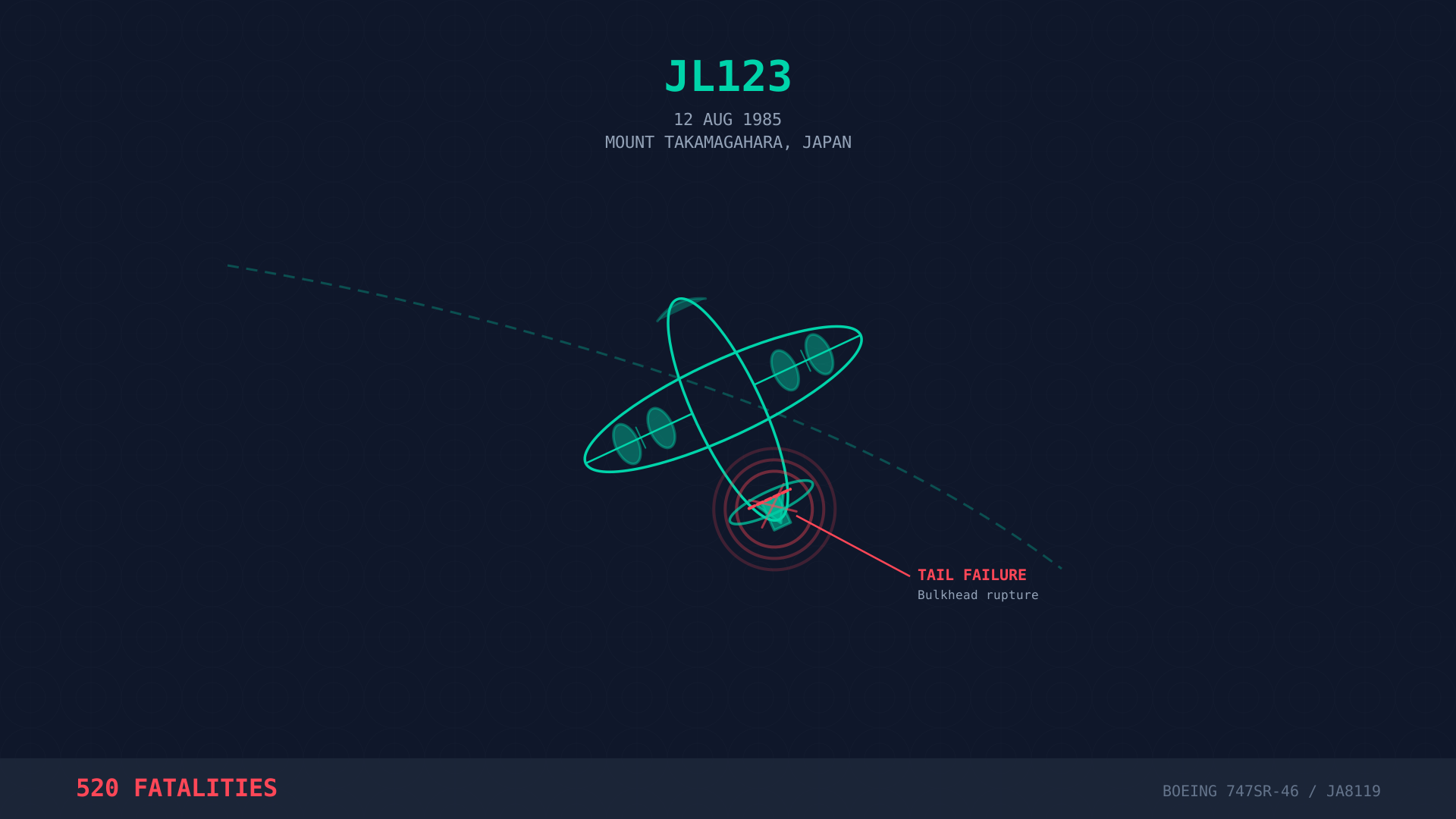
The Deadliest Single-Aircraft Disaster
On August 12, 1985, Japan Airlines Flight 123, a Boeing 747SR-46 flying from Tokyo to Osaka, crashed into Mount Takamagahara in the mountains of Gunma Prefecture, Japan. The disaster claimed 520 lives, making it the deadliest single-aircraft accident in aviation history. Only four passengers survived, all women seated in the rear of the aircraft.
A Routine Domestic Flight
Flight 123 was a routine 54-minute domestic hop from Tokyo's Haneda Airport to Osaka's Itami Airport—one of the world's busiest routes. The Boeing 747SR (Short Range) variant, registered as JA8119, was specifically designed for high-frequency, short-haul operations with a reinforced structure to withstand more takeoff and landing cycles.
On that summer evening, the aircraft carried 524 people: 509 passengers (including 12 children) and 15 crew members. Among the passengers were families returning from summer vacation, business travelers, and off-duty flight attendants heading home.
Twelve Minutes to Catastrophe
At 6:12 PM local time, just 12 minutes after takeoff and as the aircraft was climbing through 23,900 feet near Izu Ōshima island, passengers and crew heard a loud explosion. The aircraft's aft pressure bulkhead had catastrophically failed, causing explosive decompression.
The sudden release of pressurized air from the cabin into the unpressurized tail section had devastating consequences:
- The auxiliary power unit (APU) was blown out
- The vertical stabilizer was destroyed
- All four hydraulic systems were severed, resulting in complete loss of hydraulic pressure
- The aircraft lost its ability to control pitch, yaw, and roll through conventional means
Thirty-Two Minutes of Desperation
What followed was a desperate 32-minute struggle for survival. With no hydraulic control, the pilots could only use differential engine thrust to attempt to control the aircraft. The 747 began a series of erratic climbs, dives, and Dutch rolls, reaching altitudes of up to 24,000 feet before descending as low as 9,000 feet.
Captain Masami Takahama, First Officer Yutaka Sasaki, and Flight Engineer Hiroshi Fukuda worked frantically to maintain control. The cockpit voice recorder captured their professional determination: "Let's try to get to Haneda," Captain Takahama said, attempting to return to Tokyo.
Despite their skill and experience, the crew had no practical way to control the aircraft. The 747 wandered across the skies of central Japan, its erratic movements visible to observers on the ground and
to other aircraft in the vicinity.
The Final Moments
At approximately 6:56 PM, the aircraft struck Mount Takamagahara at an elevation of 5,135 feet, traveling at a high rate of speed. The impact destroyed the aircraft, creating a debris field across the mountainside. The crash site was extremely remote and difficult to access.
Due to the mountainous terrain and approaching darkness, rescue operations could not begin immediately. It wasn't until the following morning that Self-Defense Force helicopters reached the wreckage. Miraculously, four passengers—all seated in the rear of the aircraft—survived the crash and the night in the mountains:
- Yumi Ochiai, an off-duty JAL flight attendant (age 26)
- Hiroko Yoshizaki (age 34) and her daughter Mikiko (age 8)
- Keiko Kawakami (age 12)
The Root Cause: A Fatally Flawed Repair
The investigation revealed a shocking truth: the catastrophic failure had been triggered by an improper repair performed seven years earlier. In 1978, the same aircraft (JA8119) had suffered a tail strike during landing at Osaka. Boeing technicians repaired the damaged aft pressure bulkhead, but they made a critical error.
The Repair Error: The damaged section required a splice plate to be attached with multiple rows of rivets. However, instead of using a single splice plate spanning the entire damaged area with two rows of rivets, the repair crew used two separate splice plates that met end-to-end with only a single row of rivets joining them. This reduced the strength of the repair by approximately 70%.
Seven Years of Fatigue: Over the next seven years and more than 12,000 pressurization cycles, metal fatigue cracks slowly propagated from the improperly installed splice plates. Each time the aircraft pressurized and depressurized, the stress on the weakened bulkhead increased. On Flight 123, during what should have been a routine pressurization, the accumulated damage finally exceeded the structure's ability to contain cabin pressure.
Safety Improvements
The JAL 123 disaster led to significant changes in aviation maintenance and safety:
Enhanced Repair Procedures: Boeing and aviation authorities worldwide revised maintenance procedures and repair manuals, placing greater emphasis on proper techniques and quality control.
Improved Inspection Protocols: Airlines implemented more rigorous inspection schedules for pressure bulkheads and other critical structural components, with particular attention to previously repaired areas.
Better Training: Maintenance personnel received enhanced training on the critical importance of following exact procedures, especially for structural repairs.
Bulkhead Design: Aircraft manufacturers reviewed and improved pressure bulkhead designs to incorporate greater redundancy and tolerance for damage.
Loss of Control Training: The accident highlighted the need for pilot training in managing aircraft with limited or no hydraulic control. Modern flight simulators now include scenarios for "un-commandable" flight situations.
A Nation in Mourning
The disaster deeply traumatized Japan. The victims included celebrities, business leaders, and families. Singer Kyu Sakamoto, famous for the hit song "Sukiyaki" (Ue o Muite Arukō), was among those who perished.
The crash prompted soul-searching about maintenance practices and corporate responsibility. Boeing accepted responsibility for the faulty repair, and both Boeing and JAL faced intense scrutiny and legal action.
Legacy
Japan Airlines Flight 123 remains a powerful reminder that seemingly minor maintenance errors can have catastrophic consequences years later. The accident demonstrated that:
- Structural repairs must be performed exactly according to specifications
- Quality control and independent verification are essential
- Metal fatigue is a silent threat that can accumulate over many years
- Even minor deviations from proper repair procedures can prove fatal
The four survivors' stories of enduring the crash and the cold mountain night provided rare insight into survivability in severe accidents. Their testimony helped investigators understand the sequence of events and has informed cabin safety improvements.
Today, the crash site on Mount Takamagahara is marked by a memorial where families of the victims come to pay their respects. The "Osutaka no One" (Ridge of Osutaka) serves as a somber reminder of the 520 lives lost and the critical importance of uncompromising standards in aircraft maintenance.