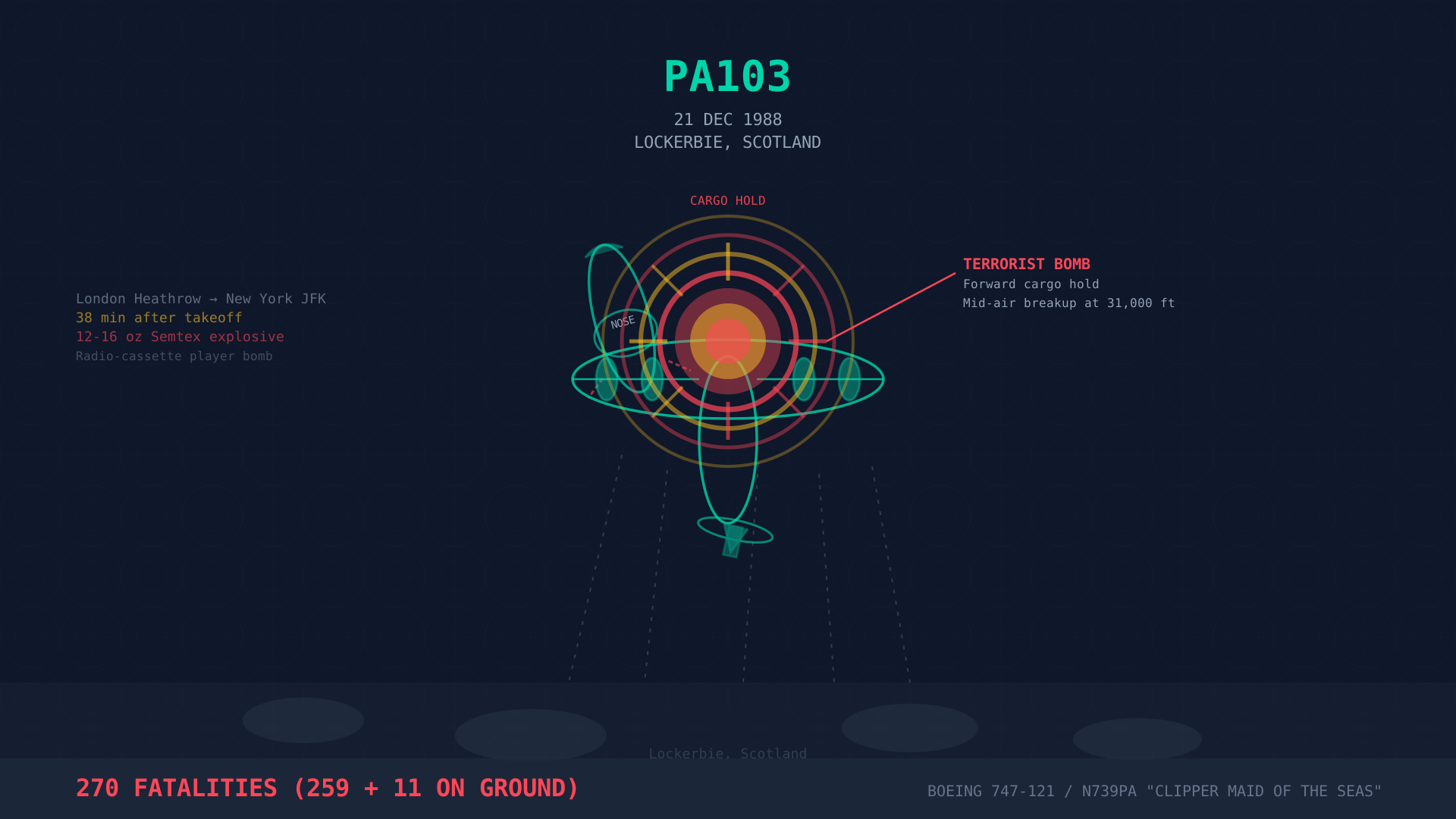
The Bombing of Clipper Maid of the Seas
On the evening of December 21, 1988, Pan Am Flight 103 was cruising peacefully at 31,000 feet over the Scottish border, bound for New York. Inside the Boeing 747 "Clipper Maid of the Seas," 243 passengers and 16 crew members were settling in for the transatlantic crossing. Many were heading home for Christmas. Thirty-five were Syracuse University students returning from a semester studying abroad.
At 7:03 PM Greenwich Mean Time, 38 minutes after takeoff from London Heathrow, a bomb hidden in a radio-cassette player inside a Samsonite suitcase in the forward cargo hold detonated.
The explosion blew a 20-inch hole in the fuselage. The sudden decompression and structural failure tore the aircraft apart in mid-air. Wreckage rained down on the Scottish town of Lockerbie. The nose section, cockpit, and forward fuselage fell largely intact into a field. The wings, still heavy with fuel, crashed into the town itself, creating a massive fireball that destroyed an entire neighborhood.
All 259 people aboard the aircraft died. Eleven residents of Lockerbie were killed on the ground, bringing the total death toll to 270.
It was the deadliest terrorist attack in British history and the deadliest attack against American civilians prior to September 11, 2001. The investigation that followed would span three continents, involve intelligence agencies from multiple nations, and take nearly three years to identify the perpetrators.
Pan Am Flight 103 fundamentally changed aviation security. It exposed the vulnerability of baggage screening systems and led to comprehensive reforms that continue to shape how we fly today.
The Flight
Pan Am Flight 103 was a regularly scheduled transatlantic service from Frankfurt, Germany, to Detroit, Michigan, with intermediate stops in London and New York. On December 21, 1988, the transatlantic leg from London Heathrow to New York's JFK Airport was operated by a Boeing 747-121, registration N739PA, named "Clipper Maid of the Seas."
The aircraft departed Frankfurt at 12:53 PM with 103 passengers who had boarded there. In London, these passengers transferred to the Boeing 747, where they were joined by 146 additional passengers who had boarded at Heathrow. The total of 243 passengers included 190 Americans, 33 Britons, and citizens from 19 other countries.
Among the passengers were:
- Thirty-five Syracuse University students returning home after a semester studying abroad through the university's Division of International Programs Abroad (DIPA). They were excited to see their families for Christmas.
- U.S. military and government personnel, including several intelligence officers.
- Families traveling together for the holidays, including young children.
- Business travelers heading home or to year-end meetings.
The crew consisted of 16 Pan Am employees: Captain James MacQuarrie, First Officer Raymond Wagner, Flight Engineer Jerry Avritt, and 13 flight attendants led by Chief Purser Jocelyn Reina.
Flight 103 pushed back from Gate 14 at Heathrow at 6:04 PM, 25 minutes late due to a delay in loading baggage. The 747 took off at 6:25 PM into the winter evening sky.
The Climb
The departure and climb proceeded normally. Captain MacQuarrie, an experienced pilot with over 11,000 flight hours, guided the jumbo jet through British airspace. The weather was clear, with excellent visibility.
At 6:56 PM, Scottish Air Traffic Control cleared Flight 103 to climb to its cruising altitude of 31,000 feet. The aircraft leveled off and settled into the cruise portion of the flight. The seatbelt sign was turned off. Passengers began moving about the cabin, retrieving books and magazines, preparing for the long flight across the Atlantic.
Flight attendants started preparing for the first beverage and meal service. In the cockpit, the crew coordinated with air traffic control and monitored the aircraft's systems. Everything was completely routine.
At 7:03:57 PM, as Flight 103 passed over the Scottish border town of Lockerbie, the aircraft's transponder signal disappeared from air traffic control radar screens.
The Explosion
At precisely 7:03 PM and 57 seconds, a Semtex plastic explosive device concealed inside a Toshiba radio-cassette player detonated in the forward cargo hold, AVE 4041, directly beneath the passenger cabin.
The bomb, later determined to contain approximately 12-16 ounces of Semtex explosive, created a blast wave traveling at supersonic speed. The explosion blew a hole approximately 20 inches in diameter in the fuselage skin and immediately depressurized the aircraft.
But the explosion itself was not what destroyed the 747. It was the catastrophic structural failure that followed.
The blast occurred at a critical location—near the intersection of several major structural components. The sudden decompression and blast damage severed critical load-bearing frames and stringers. The pressurized fuselage, already under immense stress at 31,000 feet, could no longer maintain its structural integrity.
Within three seconds of the explosion, the forward fuselage section—including the cockpit, first-class cabin, and the entire nose of the aircraft—separated from the main body. The forces were so great that the separation was nearly instantaneous.
The loss of the nose section changed the aerodynamics catastrophically. The remaining fuselage, suddenly nose-less and asymmetric, began breaking apart. The wings separated. The tail section broke away. Fuel tanks ruptured.
From the initial explosion to complete breakup took less than 30 seconds. The aircraft disintegrated at 31,000 feet, scattering wreckage across 845 square miles of Scottish countryside.
The Fall
The nose section, containing the flight deck and part of the first-class cabin, fell largely intact for nearly six miles. Investigators later determined that some crew members and passengers in this section may have remained conscious during the fall, though they would have been incapacitated by hypoxia within seconds due to the lack of oxygen at high altitude.
The main fuselage sections tumbled earthward, breaking into smaller pieces as they fell. Passengers and crew were ejected from the disintegrating aircraft. Bodies and wreckage fell like rain across the Scottish countryside.
The wing sections, still carrying thousands of gallons of aviation fuel, plummeted toward Lockerbie. When they struck the ground, the fuel ignited in a massive fireball.
Lockerbie
At 7:03 PM, residents of Lockerbie heard a sound like distant thunder. Then the sky lit up with a brilliant flash. A moment later, burning wreckage began falling from the sky.
The largest section—the center wing section and fuselage, carrying most of the remaining fuel—struck Sherwood Crescent, a residential street in Lockerbie. The impact created a fireball that rose hundreds of feet into the air. The explosion was so powerful it registered on seismographs 100 miles away.
Eleven residents of Lockerbie died instantly, their homes obliterated by the impact and fireball. An entire block of Sherwood Crescent was destroyed, leaving a crater 155 feet long and 50 feet deep. Homes were reduced to rubble, vehicles incinerated, trees stripped bare.
Wreckage continued to fall across the town and surrounding countryside. The cockpit section came to rest in a field three miles from the town. Individual fuselage sections, engines, seats, luggage, and human remains were scattered across hundreds of square miles.
Emergency services from across Scotland converged on Lockerbie. What they found was devastation beyond comprehension. The scale of the disaster—270 dead, a town struck from the sky, wreckage across an area larger than many cities—overwhelmed initial response efforts.
It quickly became clear that no one aboard Flight 103 had survived. And the evidence emerging from the wreckage suggested this was no accident.
The Investigation Begins
Investigators from the UK Air Accidents Investigation Branch (AAIB), with assistance from the FBI, Boeing, and the NTSB, began the painstaking work of recovering and examining wreckage. The investigation would become one of the largest and most complex in aviation history.
Within days, forensic evidence pointed to an explosive device. Wreckage from the forward cargo hold showed characteristic signs of explosive damage: pitting, sooting, and evidence of a powerful blast wave radiating outward from a single point.
Chemical analysis confirmed the presence of Semtex explosive residue. The pattern of damage indicated a bomb of 12-16 ounces of plastic explosive, likely concealed in luggage.
But who had planted the bomb? And how had it gotten onto the aircraft?
Unaccompanied Baggage
Investigators focused on the baggage loaded at Frankfurt and London. Pan Am's procedures required that passenger baggage be matched to boarded passengers—unaccompanied bags were not supposed to be loaded. But in 1988, these procedures were not uniformly enforced, especially for interline baggage transferring from other carriers.
Analysis of baggage loading records revealed a critical finding: a suitcase had been loaded onto Flight 103 at Frankfurt that did not match any passenger on the flight. This "interline" bag had allegedly transferred from an Air Malta flight, though Air Malta had no record of such a transfer.
Forensic examination of wreckage revealed fragments of a Samsonite suitcase, a Toshiba radio-cassette player, and clothing purchased in Malta. These items had been at the epicenter of the explosion.
The bomb had been concealed in the radio, packed in the Samsonite suitcase along with clothing to disguise its purpose, and introduced into the baggage system as unaccompanied interline luggage. It had traveled from Malta to Frankfurt to London to Flight 103 without ever being screened for explosives or matched to a passenger.
The Intelligence Investigation
As the forensic investigation progressed, intelligence agencies pursued a parallel investigation into who had built and planted the bomb.
Early theories focused on the Popular Front for the Liberation of Palestine - General Command (PFLP-GC), a terrorist organization known to be developing radio-cassette player bombs. Intelligence suggested the group had been planning attacks on aircraft.
But the evidence eventually pointed in a different direction: Libya.
In 1991, after a three-year investigation involving intelligence from multiple nations, U.S. and Scottish prosecutors issued arrest warrants for two Libyan intelligence officers:
- Abdelbaset al-Megrahi, alleged to have placed the bomb-laden suitcase onto the Air Malta flight in Malta
- Lamin Khalifah Fhimah, alleged to have assisted in the operation
The indictments alleged that the attack was carried out by Libyan intelligence agents in retaliation for U.S. military actions against Libya in 1986.
Libya initially refused to extradite the suspects. The United Nations imposed sanctions. After years of negotiations, Libya agreed in 1999 to hand over the two men for trial under Scottish law in a neutral venue: Camp Zeist in the Netherlands.
The Trial
The trial of the Lockerbie bombers began in May 2000 and lasted nine months. It was conducted under Scottish law but held in the Netherlands to ensure neutrality.
In January 2001, the court delivered its verdict:
- Abdelbaset al-Megrahi was found guilty of 270 counts of murder and sentenced to life imprisonment (later set at a minimum of 27 years)
- Lamin Khalifah Fhimah was found not guilty and released
Al-Megrahi was imprisoned in Scotland. In 2009, terminally ill with prostate cancer and given three months to live, he was released on compassionate grounds and returned to Libya, where he died in 2012.
In 2022, a third suspect, Abu Agila Mohammad Mas'ud Kheir Al-Marimi, alleged to be the bomb-maker, was taken into U.S. custody and faces charges in U.S. federal court.
The question of who ultimately ordered the bombing—whether it was Libyan leader Muammar Gaddafi, as alleged, or whether other actors were involved—remains partially unresolved.
Controversies and Questions
The Lockerbie investigation and trial have been surrounded by controversy:
Questions about the verdict: Some investigators and legal experts have questioned whether al-Megrahi was truly guilty, pointing to inconsistencies in the evidence and suggesting that other actors may have been responsible.
Intelligence failures: How did intelligence agencies fail to prevent the attack despite indications that PFLP-GC and other groups were planning aircraft bombings?
Security failures: How did an unaccompanied suitcase containing a bomb pass through multiple airports without detection?
The warning: The U.S. State Department had received a warning about a potential attack on a Pan Am aircraft from Frankfurt to the United States. Why was this warning not acted upon more aggressively?
These questions continue to be debated. Many families of victims believe the full truth has not been revealed.
Safety Changes
Pan Am Flight 103 led to fundamental changes in aviation security:
Positive Passenger Bag Match: Airlines worldwide implemented strict requirements that all checked baggage must be matched to a boarded passenger. Unaccompanied bags are not loaded, or if they are (for legitimate reasons like connecting flights), they receive enhanced screening.
Explosive Detection Systems (EDS): Airports installed sophisticated explosive detection equipment capable of identifying explosive materials in baggage. These systems use CT scanning and other technologies to screen all checked bags.
Secure Baggage Handling: Baggage handling areas became secure zones with controlled access, video surveillance, and tamper-evident seals on cargo containers.
Blast-Resistant Cargo Containers: Airlines began using cargo containers designed to contain or mitigate explosions, preventing hull rupture.
Enhanced Screening: Screening procedures for both passengers and baggage were comprehensively overhauled, creating the multilayered security systems we know today.
International Cooperation: The attack demonstrated the need for international cooperation on aviation security. Standards were harmonized across countries.
Intelligence Sharing: Intelligence agencies and law enforcement improved information sharing about terrorist threats to aviation.
The Memorial at Syracuse
Syracuse University, which lost 35 students in the bombing, created an extensive memorial and remembrance program. The university's Remembrance and Lockerbie Scholars Program honors the victims and promotes international understanding.
Every year on December 21, Syracuse holds a Remembrance Week with ceremonies, events, and the reading of all 270 names. A Place of Remembrance on campus features a Wall of Remembrance with the names of all 35 students and the other 235 victims.
The Lockerbie Scholars Program brings students from Scotland to Syracuse each year, creating a living memorial through education and international exchange.
The Memorial at Lockerbie
In Lockerbie, the Dryfesdale Cemetery Garden of Remembrance was established to honor the victims. It contains memorial stones for all 270 victims and has become a place of pilgrimage for families and those who remember.
The town of Lockerbie itself bears permanent scars from that December evening. Sherwood Crescent was rebuilt, but the memory of what happened there remains. December 21 is observed each year with memorial services attended by townspeople, families of victims, and officials from around the world.
The End of Pan Am
For Pan American World Airways, Flight 103 was a devastating blow both human and corporate. The airline faced intense criticism for security failures. Lawsuits from victims' families mounted.
Already struggling financially, Pan Am could not recover. The airline declared bankruptcy and ceased operations in 1991, just three years after Lockerbie. One of aviation's most storied carriers, the airline that had pioneered transatlantic jet service and circumnavigated the globe, was gone.
While Pan Am's financial troubles predated Lockerbie, the bombing accelerated the airline's demise and destroyed what remained of public confidence in the carrier.
Legacy
Pan Am Flight 103 demonstrated that aviation faces threats beyond mechanical failure and human error. Terrorists had successfully destroyed a modern airliner with a device small enough to fit in a suitcase, exploiting gaps in security procedures that airlines and airports had assumed were adequate.
The 270 victims—students excited for Christmas, families returning home, crew members serving their passengers, and residents of Lockerbie simply living their lives—died because security systems failed to detect and prevent a terrorist attack.
Their deaths led to the comprehensive aviation security apparatus we know today: explosive detection systems, positive bag match requirements, secure baggage areas, and international cooperation on security standards.
Every time we remove our shoes at airport security, every time our bags pass through explosive detection systems, every time an unaccompanied bag is removed from a flight, we are living with the legacy of Lockerbie.
Remembering the 270
The memorial at Lockerbie bears 270 names. Each represents not just a victim of terrorism, but a person whose life had value, whose future was stolen, whose family was shattered.
Thirty-five Syracuse University students who will never graduate, never start careers, never raise families.
Families traveling together who died together.
Flight attendants and pilots who had dedicated their lives to making air travel safe and comfortable.
Residents of Lockerbie who were simply at home on a December evening.
Pan Am Flight 103 stands as a permanent reminder that the fight against terrorism requires constant vigilance, that security systems are only as strong as their weakest link, and that failures in security do not just allow attacks—they enable murders.
The investigation, trial, and debates continue. But the fundamental truth remains: 270 people died on December 21, 1988, because a terrorist planted a bomb on an aircraft and security systems failed to detect it.
Their memory demands that we never become complacent, that we continuously improve security, and that we remember the price of failure.
Each December 21, the names are read. The memorial stands. And the world remembers that Lockerbie was not just an aviation disaster—it was mass murder, and it changed aviation forever.