The Landing That Should Have Saved Them
On August 19, 1980, Saudia Flight 163 experienced every pilot's nightmare—a fire in flight. The crew responded professionally, diagnosing the problem and executing a successful emergency landing at Riyadh International Airport. The aircraft touched down safely, rolled to a stop, and for several precious minutes, everyone aboard was still alive.
Then, inexplicably, nothing happened.
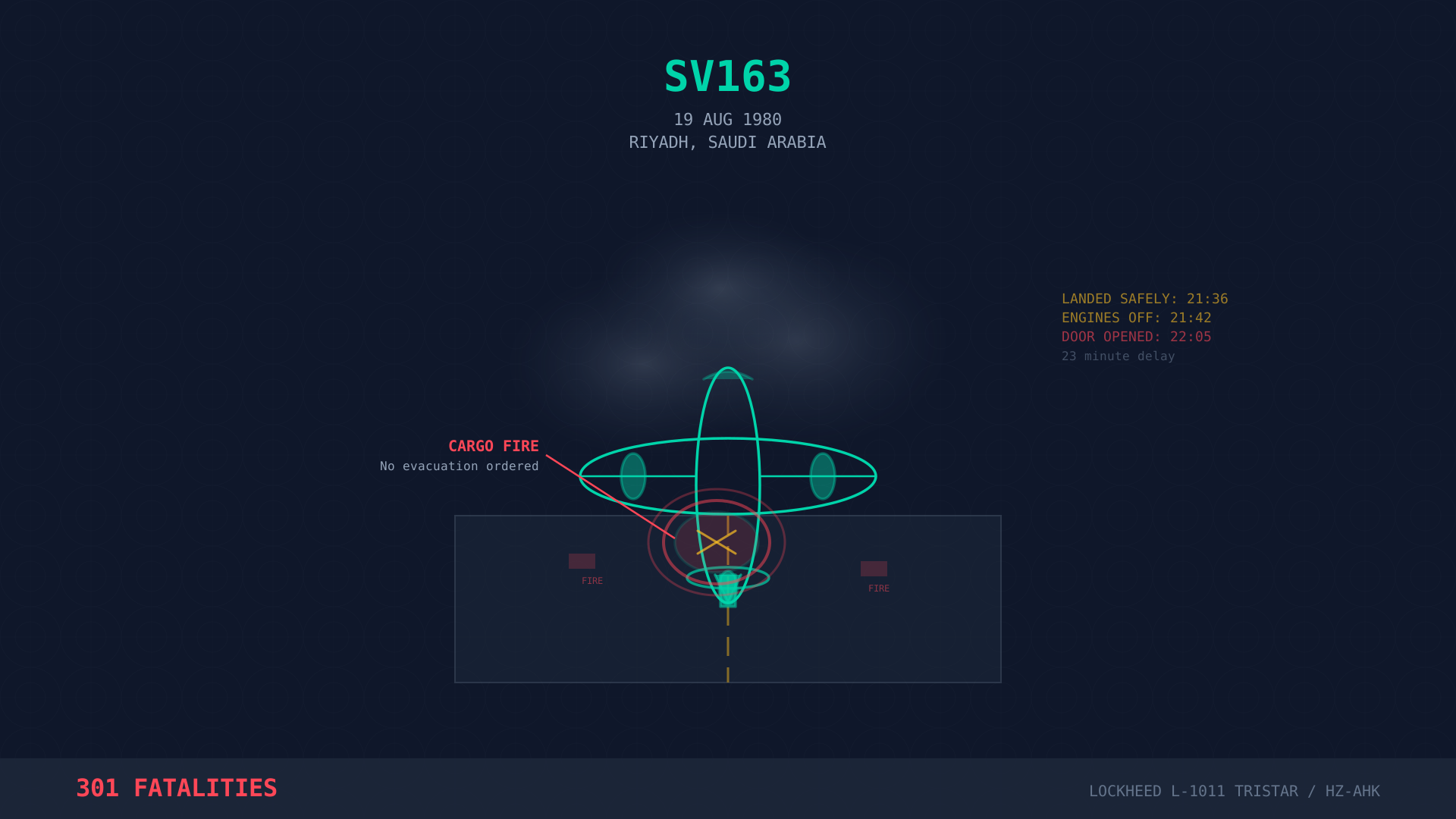
Twenty-three minutes after the engines were shut down, ground crews finally managed to open the aircraft doors. When they did, the interior immediately flashed over in a massive fireball. All 301 people on board—287 passengers and 14 crew members—were found dead inside the aircraft, victims of smoke inhalation. They had survived the fire in flight and the emergency landing, only to die waiting for an evacuation order that never came.
It remains one of aviation's most haunting tragedies: a disaster that was survivable, an emergency landing that succeeded, and a crew that, for reasons never fully understood, failed to save a single life.
A Routine Flight Home
Saudia Flight 163 departed Karachi, Pakistan, on the evening of August 19, 1980, bound for Jeddah, Saudi Arabia, with an intermediate stop at Riyadh. The Lockheed L-1011-200 TriStar, registration HZ-AHK, was a modern wide-body tri-jet equipped with state-of-the-art fire detection and suppression systems.
Captain Mohammed Ali Khowyter, an experienced pilot, commanded the aircraft. First Officer Sami Abdullah Hasanain and Flight Engineer Bradley Curtis rounded out the flight deck crew. The cabin crew consisted of 11 flight attendants led by Chief Purser Fahad Al-Ghamdi.
The aircraft carried 287 passengers, most of them Saudi nationals and Pakistani workers returning home from Pakistan. Many were families, including numerous children.
The flight departed Karachi on schedule and proceeded without incident toward Riyadh.
Seven Minutes After Takeoff
At 9:08 PM local time (18:08 UTC), Flight 163 lifted off from Riyadh International Airport, departing for the final leg to Jeddah. Just seven minutes later, at 9:14 PM, the first indication of trouble appeared.
An aural warning sounded in the cockpit: smoke detected in the aft cargo compartment, designated C3. This compartment, located in the rear lower fuselage, contained passenger baggage and cargo.
The crew's response was methodical and professional. They consulted their checklists and emergency procedures. Flight Engineer Curtis went back into the cabin to visually confirm the presence of smoke. He returned to report that yes, smoke was visible—and it was getting worse.
The Decision to Return
At 9:18 PM, just four minutes after the first warning, Captain Khowyter made the decision to return to Riyadh. It was the correct call, made quickly and decisively.
Air traffic control cleared Flight 163 for an immediate return. The crew began configuring the aircraft for landing while simultaneously trying to determine the extent and source of the fire.
The smoke was becoming more intense. Passengers in the rear of the aircraft could see and smell it. Some began to panic, though the cabin crew tried to maintain order.
The L-1011's cargo compartment fire suppression system had been activated, but it appeared to have little effect. The fire—wherever it was burning and whatever was feeding it—continued to spread.
The Landing
At 9:29 PM, Flight 163 was on final approach to Riyadh. The aircraft was heavy with fuel, making the landing more challenging, but Captain Khowyter executed it smoothly.
At 9:36 PM—28 minutes after the initial fire warning—the L-1011's main landing gear touched down on Riyadh's runway. The landing was successful. By all accounts, it was a textbook emergency return and landing under difficult circumstances.
The aircraft rolled down the runway, decelerating normally. At 9:39 PM, it came to a complete stop on a taxiway adjacent to the runway.
For the next few minutes, everyone aboard Flight 163 was still alive. Many were likely suffering from smoke inhalation, but they were alive. Ground emergency services were racing toward the aircraft. Evacuation slides were ready to deploy. Escape was possible.
But nothing happened.
The Fatal Delay
What occurred—or rather, what failed to occur—during the next twenty-three minutes remains one of aviation's most disturbing mysteries.
The cockpit voice recorder captured Captain Khowyter's voice issuing an order that would seal the fate of everyone aboard:
"Tell them—tell them not to evacuate."
Why? The CVR provided no clear answer. Captain Khowyter, a professional pilot who had just executed a successful emergency landing, gave an order that contradicted every emergency procedure, every training scenario, and all common sense.
The engines continued running. The aircraft remained pressurized. The plug-type doors, designed to open outward, were held in place by internal cabin pressure. Even if the cabin crew or passengers had tried to open them, they likely couldn't have.
At 9:42 PM—three minutes after stopping—the engines were finally shut down. But still, no evacuation order was given. The cabin pressure began to slowly equalize, but the doors remained closed.
Outside, firefighters surrounded the aircraft, foam and water at the ready. They waited for the doors to open. They could see smoke inside. They knew people were in there. But protocol required that the crew open the doors from inside.
Minutes passed. The smoke inside the cabin grew thicker and more toxic. Passengers who might have walked away from an immediate evacuation were now being overcome by smoke inhalation. The fire, starved of oxygen in the pressurized cabin but still burning, was spreading.
The Flashover
At 10:05 PM—twenty-three minutes after the aircraft came to a stop—ground personnel finally managed to force open the R2 door on the right side of the aircraft.
The result was immediate and catastrophic. Fresh oxygen rushed into the smoke-filled cabin. The fire, which had been smoldering, suddenly had the air it needed.
Three minutes later, at 10:08 PM, the entire interior of the aircraft flashed over. In seconds, a massive fireball engulfed the cabin. The intense heat and flames destroyed everything inside.
When firefighters finally extinguished the blaze and entered the aircraft, they found all 301 bodies. Forensic analysis would later determine that everyone had died from smoke inhalation before the flashover. Most had been dead for several minutes by the time the door was opened.
The irony was crushing: the flashover that prevented rescue had occurred after everyone was already dead from a delay that never should have happened.
The Investigation
Saudi Arabian authorities, assisted by the U.S. National Transportation Safety Board and Lockheed, launched an investigation. What they discovered raised more questions than answers.
The Unknown Fire Source
Despite extensive investigation, the origin of the fire could not be conclusively determined. Investigators found two butane camping stoves in the wreckage of cargo compartment C3, along with a used fire extinguisher nearby. Early theories suggested a passenger might have been using a stove to heat water for tea, a practice sometimes seen among passengers on regional flights.
However, there was no evidence that the stoves had caused the fire. In fact, there was no conclusive evidence of what started the fire at all. It remains one of aviation's unsolved mysteries.
The Inexplicable Delay
The more troubling question was why Captain Khowyter delayed the evacuation. Several theories emerged:
Cultural Deference: Analysis of the cockpit voice recorder suggested that a "power distance" dynamic may have played a role. The CVR captured Chief Purser Al-Ghamdi repeatedly requesting that the captain order an evacuation. Captain Khowyter ignored these requests. In some cultures, subordinates are reluctant to forcefully challenge a superior's decisions, even in emergencies.
Pressurization Issues: The aircraft's plug-type doors could not be opened while the cabin remained pressurized. The pressurization system had been left on standby during the landing, keeping the cabin pressurized longer than necessary. However, this doesn't explain why the captain ordered the crew not to evacuate, or why depressurization procedures weren't followed.
Situational Awareness: Some investigators theorized that Captain Khowyter may not have fully grasped the severity of the situation. Perhaps he believed the fire suppression system had controlled the fire, or that the smoke was dissipating. But this theory is difficult to reconcile with his apparent awareness that there was a fire serious enough to require an emergency landing.
Incapacitation: By the time the aircraft stopped, Captain Khowyter may have been suffering from smoke inhalation himself, impairing his judgment. However, the CVR showed him communicating clearly in the minutes after landing.
The truth is we will never know. Captain Khowyter died with his passengers and crew, taking his reasoning to the grave.
The Calculations That Haunt
Investigators performed a crucial calculation: if the aircraft had been stopped as quickly as possible on the runway, and if the captain had ordered an immediate evacuation, how many people would have survived?
The answer was devastating: probably everyone.
The L-1011 had eight exits, multiple emergency slides, and a well-trained cabin crew. Even accounting for the smoke and confusion, an immediate evacuation would have allowed most if not all passengers to escape.
Instead, everyone died waiting in their seats while the smoke slowly overcame them.
Safety Improvements
The tragedy of Saudia Flight 163 led to significant changes in aviation safety:
Crew Resource Management (CRM): The accident highlighted the dangers of excessive power distance in cockpits. CRM training was enhanced to emphasize that any crew member should be empowered—and expected—to intervene in emergencies, regardless of rank.
Evacuation Protocols: Airlines revised procedures to mandate immediate evacuation following any emergency landing where fire or smoke is involved. The default became "evacuate first, assess later."
Pressurization Systems: Changes were made to ensure that aircraft pressurization systems automatically shut down upon landing when emergency modes are activated.
Cargo Compartment Fire Detection: The accident led to improvements in cargo fire detection systems and procedures for dealing with cargo fires in flight.
Door Design Considerations: Manufacturers examined whether plug-type doors, while excellent for structural integrity, posed evacuation challenges. Various quick-depressurization systems were developed.
The Persistent Questions
What makes Saudia Flight 163 particularly haunting is not just the death toll, but the persistent questions:
- What started the fire? Despite extensive investigation, the source was never determined.
- Why did Captain Khowyter order his crew not to evacuate? His reasoning died with him.
- Could the cabin crew or passengers have opened the doors themselves? Protocol and hierarchy prevented them from trying.
- How long did it take for passengers to realize they weren't being evacuated? The CVR didn't capture cabin sounds.
- Did anyone try to force the doors open? We don't know.
Legacy
Saudia Flight 163 remains the deadliest accident involving a Lockheed L-1011 TriStar and the deadliest aviation disaster in Saudi Arabian history.
The 301 victims—men, women, and children traveling home from Pakistan—died in perhaps the cruelest way imaginable: they survived the emergency, survived the landing, and then died waiting for rescue that was mere feet away but might as well have been miles.
Their tragedy fundamentally changed how aviation approaches emergencies. Today, pilots are trained that in any situation involving fire or smoke, the default response after landing is immediate evacuation. Questions can be asked later; explanations can be given later. First, get everyone off the aircraft.
The burned-out hulk of HZ-AHK serves as a permanent reminder that in aviation emergencies, hesitation kills. The difference between survival and tragedy can be measured not in hours or minutes, but in seconds.
Every subsequent aviation emergency where crews have ordered immediate evacuations—and saved lives as a result—stands as a tribute to the 301 people who died on Saudia Flight 163. Their deaths taught the aviation world a lesson written in the starkest possible terms: when there's fire or smoke, every second counts. Evacuate first. Always.