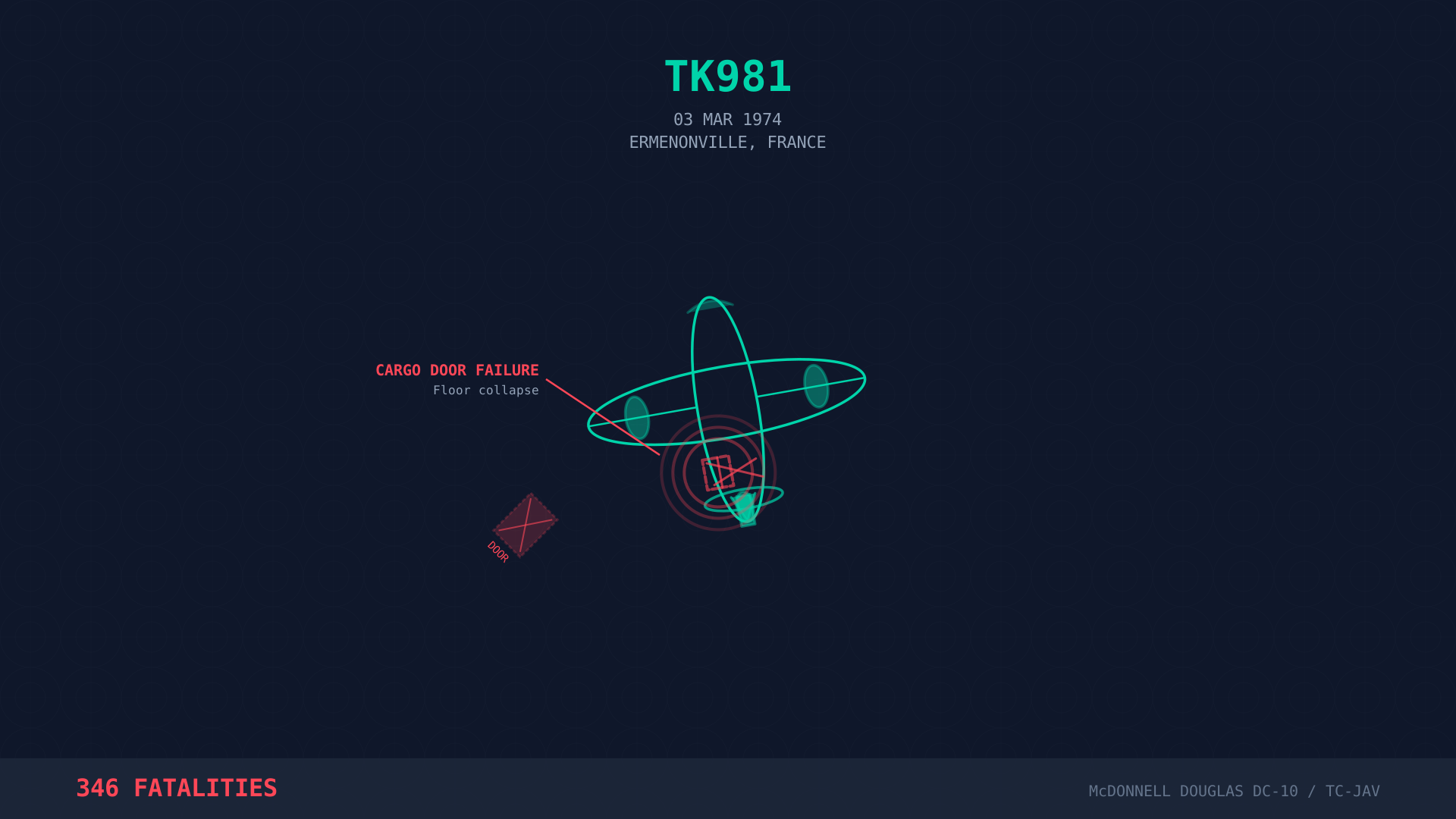
The Warning Ignored
On March 3, 1974, Turkish Airlines Flight 981 crashed into the Ermenonville Forest outside Paris, killing all 346 people on board. It was aviation's deadliest single-aircraft accident at the time. The tragedy was made all the more devastating by one inescapable fact: it was entirely preventable. Nearly two years earlier, an identical failure had occurred on another DC-10, and the crew had managed to land safely. But warnings about the fatal design flaw were ignored, and 346 people paid the ultimate price.
A Routine International Flight
Turkish Airlines Flight 981 departed Istanbul's Yeşilköy Airport on the morning of March 3, 1974, bound for London Heathrow Airport with a scheduled stop in Paris. The McDonnell Douglas DC-10-10, registration TC-JAV, was a modern wide-body tri-jet that had entered service less than two years earlier.
Captain Nejat Berköz, 44, commanded the aircraft, assisted by First Officer Oral Ulusman, 38, and Flight Engineer Erhan Özer, 37. The Turkish crew was experienced and well-trained on the DC-10.
The Paris Stop
The flight arrived at Paris Orly Airport around noon for a scheduled passenger stop. The aircraft took on 216 additional passengers, bringing the total to 335 passengers plus 11 crew members—346 people in all.
Many of the passengers were British citizens who had been stranded in Istanbul when a British Airways strike disrupted their travel plans. Turkish Airlines had stepped in to help, offering reduced fares. Among the passengers were members of a rugby team, Japanese and British tourists, and business travelers from multiple countries.
Just after 12:30 PM, Flight 981 pushed back from Gate F3 and taxied for departure.
Seventy-Seven Seconds
At 12:32 PM, Flight 981 took off from Runway 08 and began climbing toward its cruising altitude. Captain Berköz flew the aircraft manually while First Officer Ulusman handled radio communications with air traffic control.
The aircraft climbed through 11,500 feet and was cleared to continue to Flight Level 230 (23,000 feet). Everything appeared normal.
But at approximately 12:40 PM, as the aircraft passed over the town of Meaux about 40 kilometers northeast of Paris, disaster struck.
The Door That Should Have Held
The rear left cargo door—officially designated the aft cargo compartment door—suddenly blew off the aircraft. The separation was catastrophic and immediate.
When the door tore away, the pressurized air inside the cargo hold explosively decompressed. The sudden pressure differential between the cargo area (now at ambient pressure) and the passenger cabin above it (still pressurized) was immense—roughly 8 pounds per square inch across hundreds of square feet.
The floor of the passenger cabin couldn't withstand the force. A large section of the cabin floor—approximately 7.5 meters long—tore away and was violently ejected through the gaping hole where the cargo door had been. Six passenger seats, still occupied, went with it.
Catastrophic System Failure
The loss of the floor section had consequences far beyond the tragic deaths of the six passengers ejected from the aircraft. Beneath that section of floor ran critical flight control cables—cables that controlled the rudder, elevators, and the number two engine.
When the floor collapsed and was ripped away, these cables were severed. Instantly, the pilots lost the ability to control:
- The rudder (directional control)
- The elevator trim (pitch control)
- The number two tail-mounted engine (thrust)
Captain Berköz and First Officer Ulusman found themselves in command of an uncontrollable aircraft. The DC-10 immediately began to pitch down and turn to the left.
Seventy-Seven Seconds to Impact
The cockpit voice recorder captured the pilots' desperate attempts to regain control. Despite their training and experience, they had no way to know the true extent of the damage. They didn't know that critical control cables had been severed, that six passengers had been ejected, or that a massive hole now existed in the rear fuselage.
All they knew was that the aircraft wasn't responding to their inputs.
The DC-10 entered a steep dive, turning left and accelerating rapidly. The pilots tried everything—differential thrust on the remaining engines, manual trim inputs, desperate pulls on the control column. Nothing worked.
Seventy-seven seconds after the cargo door separated, at 12:41 PM, Flight 981 struck the ground at a nearly vertical angle in the Ermenonville Forest. The aircraft was traveling at approximately 430 knots (800 km/h).
The impact was catastrophic. The DC-10 disintegrated instantly, scattering wreckage across a wide swath of forest. All 346 people aboard died instantly. There were no survivors.
The Scene
The crash site was devastating. Wreckage was strewn through the forest over an area roughly 500 meters wide. The force of the impact had completely destroyed the aircraft—there were no large, recognizable pieces, only fragments and debris.
Recovery teams faced the grim task of searching the forest. Among the first discoveries were the bodies of the six passengers who had been ejected when the floor collapsed. They were found in a field near the town of Saint-Pathus, about 15 kilometers from the main crash site—still strapped in their seats.
The Investigation Begins
French accident investigators, assisted by teams from McDonnell Douglas, the FAA, and the NTSB, began piecing together what had happened. The rear cargo door was found relatively intact several kilometers from the main wreckage, providing critical evidence.
What they discovered was shocking: the design of the cargo door latch mechanism was fatally flawed, and warnings about that flaw had been ignored for nearly two years.
American Airlines Flight 96: The Warning
On June 12, 1972—almost two years before Flight 981—American Airlines Flight 96, a DC-10, experienced an identical cargo door failure shortly after takeoff from Detroit. The aft cargo door blew off, causing rapid decompression and partial floor collapse.
However, the crew of Flight 96—Captain Bryce McCormick, First Officer Peter Whitney, and Flight Engineer Clayton Burke—managed to land the aircraft safely using differential engine thrust to maintain control. All 67 people aboard survived with only minor injuries.
The National Transportation Safety Board investigated and issued clear recommendations:
- The cargo door latch mechanism needed to be redesigned
- The cabin floor needed to be strengthened to prevent collapse
- Proper failsafe mechanisms needed to be installed
The Failures That Followed
What happened next remains one of aviation's most troubling examples of regulatory and corporate failure:
McDonnell Douglas argued that Flight 96 was an isolated incident and made only minimal changes. They:
- Added a small viewing window to help ground crew verify latch position
- Issued a service bulletin (not mandatory) recommending support plate modifications
- Lobbied hard against mandatory modifications
The FAA initially prepared an Airworthiness Directive that would have grounded all DC-10s until modifications were made. However, after pressure from McDonnell Douglas—whose President met directly with the FAA Administrator—the agency instead accepted a voluntary "gentleman's agreement" that allowed the manufacturer to fix the problem at their own pace.
Convair (the subcontractor who built the fuselage) had actually predicted this exact failure mode in an internal memo before Flight 96 occurred. Their engineer concluded it would likely result in loss of aircraft and loss of life. The memo was largely ignored.
The Fatal Combination
On Turkish Airlines Flight 981, several factors combined with deadly effect:
The latching mechanism allowed the door to appear closed even when the latches were not properly engaged. The locking pins could bypass their proper positions if enough force was applied.
The support plate that was supposed to prevent this had been ordered installed on TC-JAV's cargo door. Paperwork showed it had been completed. But when investigators examined the wreckage, they discovered the support plate had never actually been installed.
The ground handler who closed the cargo door in Paris did not speak Turkish or English—the only languages on the warning placard about proper latching procedures.
The viewing window added after Flight 96 was small and difficult to see through. The ground handler reportedly looked through it and thought he saw the latches engaged, when in fact they were not.
The Aftermath
The crash of Turkish Airlines Flight 981 prompted immediate action that should have happened two years earlier:
Immediate Grounding: While the DC-10 was not formally grounded, many airlines voluntarily pulled their DC-10s from service pending inspections.
Mandatory Modifications: The FAA finally issued mandatory Airworthiness Directives requiring:
- Complete redesign of the cargo door latch mechanism
- Installation of vent doors that would prevent pressurization if the cargo door wasn't properly latched
- Strengthening of the cabin floor to withstand pressure differential
- Redundant routing of flight control cables so a floor collapse couldn't sever all controls
Regulatory Changes: The accident led to reforms in how the FAA certified aircraft and how seriously they treated manufacturer warnings about design flaws.
Legal Action: Turkish Airlines and McDonnell Douglas faced extensive litigation. Eventually, McDonnell Douglas paid substantial damages to victims' families.
The Convair Engineer's Moral Dilemma
Perhaps the most haunting aspect of Flight 981 is the case of Dan Applegate, the Convair engineer who wrote the warning memo in 1972. After Flight 981, he was asked why he hadn't gone public with his concerns.
His response revealed the impossible position engineers often face: he had reported the problem through proper channels. Management had been informed. But as a mid-level engineer, defying his company's decision would have meant the end of his career, and possibly wouldn't have changed the outcome anyway.
Flight 981 exposed how corporate and regulatory systems can fail even when individuals within those systems try to do the right thing.
Legacy
Turkish Airlines Flight 981 remains France's deadliest aviation accident and held the record for deadliest single-aircraft accident until Japan Airlines Flight 123 in 1985.
The 346 victims came from multiple countries—British rugby players heading home, Japanese tourists, Turkish families, and business travelers from around the world. Their deaths drove home a crucial lesson: in aviation, a known problem must be fixed immediately, not when it's convenient or economical.
The accident fundamentally changed how aviation authorities handle safety warnings. The "gentleman's agreement" approach to safety compliance died in the Ermenonville Forest. Today, when a critical design flaw is discovered, mandatory modifications are required, not suggested.
The disaster also reinforced the importance of redundancy in critical systems. Modern aircraft are designed so that a single failure—even a catastrophic one like a cargo door separation—cannot compromise multiple independent flight control systems.
Every McDonnell Douglas DC-10 and its derivative, the MD-11, carries modifications that exist because of Flight 981. The cargo door that failed that March afternoon was redesigned to make such a failure virtually impossible. The cabin floor was strengthened to withstand pressure differentials. Flight control cables were rerouted to provide redundancy.
These changes came too late for the 346 people aboard Turkish Airlines Flight 981, but their tragedy ensured that such a preventable accident would never happen again. In aviation safety, that is their legacy: lessons written in the sky above a French forest, in memory of lives that should never have been lost.