The Explosion Nobody Expected
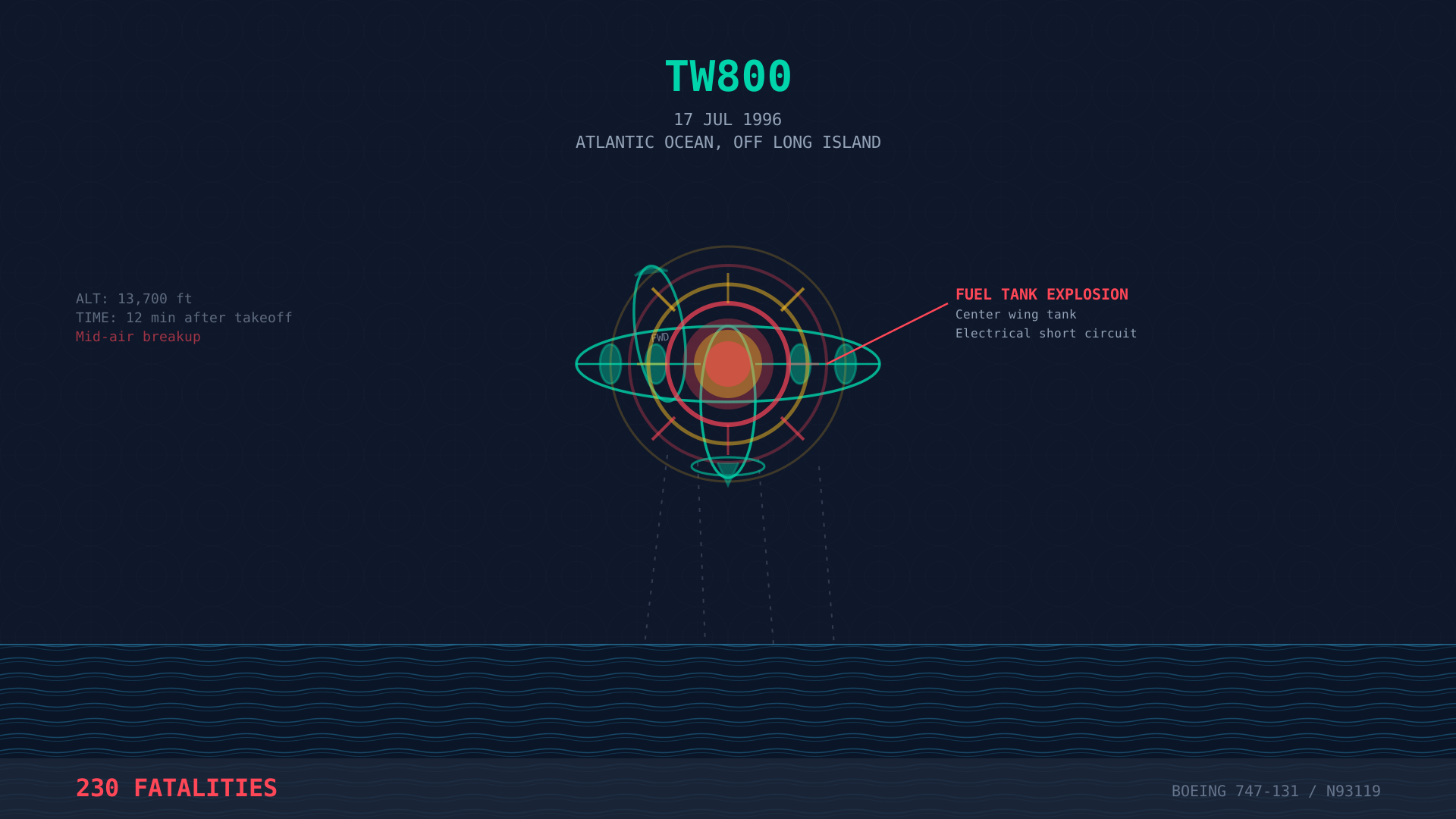
On the evening of July 17, 1996, TWA Flight 800 climbed into the twilight sky over Long Island, bound for Paris. Twelve minutes into the flight, at 13,700 feet over the Atlantic Ocean, the Boeing 747 suddenly exploded. The center wing fuel tank ruptured in a massive fireball, tearing the aircraft apart in mid-air.
All 230 people aboard—212 passengers and 18 crew members—died instantly or in the fall into the ocean that followed.
The explosion was witnessed by hundreds of people on the ground and on boats. Many reported seeing a streak of light rising toward the aircraft before it exploded, spawning immediate speculation about terrorism, missiles, or sabotage. The crash occurred less than a month before the 1996 Summer Olympics in Atlanta, at a time of heightened concern about terrorism following the 1993 World Trade Center bombing and the 1995 Oklahoma City bombing.
What followed was one of the largest, most expensive, and most controversial investigations in aviation history. The NTSB would spend four years examining every possibility—terrorist bomb, missile strike, mechanical failure—before reaching a conclusion that fundamentally changed how aircraft fuel tanks are designed.
The Flight
TWA Flight 800 was scheduled to depart New York's John F. Kennedy International Airport at 7:00 PM EDT, bound for Paris Charles de Gaulle Airport. The aircraft was a Boeing 747-131, registration N93119, a 25-year-old jumbo jet that had been in TWA's fleet since 1971.
Captain Ralph Kevorkian, 58, commanded the flight. An experienced TWA captain with over 18,800 flight hours, Kevorkian was known as a meticulous, by-the-book pilot. First Officer Steven Snyder, 57, sat in the right seat. Flight Engineer Richard Campbell Jr., 63, rounded out the cockpit crew. The cabin crew consisted of 15 flight attendants.
The passenger manifest included families heading to Paris for vacation, students on educational trips, and business travelers. Among them were members of a French club from Montoursville, Pennsylvania—a group of 16 students and 5 adult chaperones excited for their trip to France.
The flight was delayed for nearly two hours due to a disabled piece of ground equipment and a passenger-baggage mismatch that required the removal of luggage. The aircraft finally pushed back from the gate at 8:02 PM.
Takeoff and Climb
At 8:19 PM, TWA Flight 800 was cleared for takeoff from Runway 22R at JFK. The 747's four engines spooled up and the heavy aircraft accelerated down the runway, lifting off smoothly into the clear summer evening.
The flight proceeded normally. The crew contacted New York Departure Control and began their climb toward their assigned cruising altitude of 15,000 feet for the initial portion of the flight. Weather was excellent—visibility unlimited, light winds, no turbulence.
At 8:29 PM, as the aircraft climbed through 13,700 feet about 10 miles south of the Long Island coast, First Officer Snyder acknowledged a frequency change instruction from air traffic control.
Those were the last words heard from TWA Flight 800.
The Explosion
At 8:31:12 PM—twelve minutes and eleven seconds after takeoff—the Boeing 747's center wing fuel tank exploded.
The tank, located in the center section of the wing between the two fuselages, had been nearly empty—containing only about 50 gallons of jet fuel in residual puddles and vapor. But that vapor, combined with the air in the tank, created a highly explosive mixture. All it needed was an ignition source.
When the fuel-air mixture ignited, the explosion was catastrophic. The overpressure inside the tank was so great that it ruptured the tank structure, blowing out the bottom of the center wing section. The blast wave tore through adjacent structure, severing critical load-bearing members.
The forward fuselage section—containing the cockpit and first-class cabin—separated almost immediately. Without the forward section, the remaining aircraft pitched up sharply. The forces tore the aircraft into multiple pieces.
From the ground and from boats on the water, hundreds of witnesses saw the explosion. Many described a fireball in the sky. Many also reported seeing a streak of light—variously described as white, yellow, or red—rising from the surface toward the aircraft before or during the explosion.
The radar track showed Flight 800's transponder signal disappear at 8:31:12 PM. Debris began falling into the Atlantic Ocean in a pattern that would eventually stretch across several miles of ocean floor.
The Witnesses
Within minutes of the explosion, emergency calls flooded 911 centers across Long Island. Coast Guard stations received reports of an aircraft in the water. Boats in the area raced toward the debris field.
What they found was horrific. The ocean surface was covered with wreckage—sections of fuselage, seats, luggage, and bodies. Jet fuel burned on the water's surface. The smell of aviation fuel hung in the air.
But it was the witness accounts that immediately drove the investigation in a specific direction. Dozens—eventually more than 200—credible witnesses reported seeing a "streak of light" or "flare" moving upward toward the aircraft before the explosion.
An experienced helicopter pilot on Long Island saw what he described as a "red flare" rising from the ocean toward the aircraft. A retired Air National Guard pilot saw what looked like a "firework" ascending toward Flight 800. Multiple people on the ground described similar observations.
The immediate assumption was clear: TWA Flight 800 had been shot down.
The Investigation Begins
The FBI took over the investigation within hours, treating it as a potential crime scene. Agents began interviewing witnesses, examining evidence, and pursuing the possibility of terrorism or a deliberate act.
The NTSB, responsible for investigating aviation accidents, launched its own team but found itself operating under FBI oversight—an unusual and sometimes contentious arrangement.
Three theories dominated the early investigation:
Terrorist Bomb: Had a bomb been placed aboard the aircraft, possibly in the cargo hold or baggage compartment?
Missile Strike: Had the aircraft been hit by a surface-to-air missile, either from a boat or from land?
Mechanical Failure: Had some mechanical or electrical failure caused the explosion?
The FBI pursued the first two theories aggressively. The NTSB focused on the third.
The Recovery
Recovering the wreckage from the Atlantic Ocean became a massive undertaking. The debris field covered 75 square nautical miles in water up to 120 feet deep. The NTSB was determined to recover as much of the aircraft as possible—a goal unprecedented in an over-water accident.
Navy ships, Coast Guard vessels, commercial salvage companies, and submersible robots worked for months to locate and retrieve wreckage. Divers worked in difficult conditions—cold water, poor visibility, strong currents, and the psychological burden of recovering human remains.
By November 1996, investigators had recovered enough wreckage to make a significant discovery: there was no evidence of a bomb.
Explosive residue testing found no indication of military or commercial explosives. The damage patterns on recovered wreckage did not match bomb damage. Cargo containers showed no signs of explosive penetration.
The bomb theory was effectively eliminated.
The Missile Theory
The missile theory proved harder to dismiss. The witness accounts were compelling, and the explosion had occurred in airspace where military exercises sometimes took place.
The FBI and NTSB investigated exhaustively:
- All military assets in the area were accounted for. No missiles were fired.
- Radar data showed no missile tracks.
- Recovered wreckage showed no damage consistent with missile impact—no fragmentation patterns, no explosive residue matching missile warheads, no penetration holes.
- Chemical analysis of wreckage found no traces of rocket fuel or missile propellant.
But what about the witnesses? If 200+ people saw a streak of light, what did they see?
Investigators eventually determined that many witnesses likely saw the aircraft after the initial explosion, when the fuselage—still on fire and with engines running—climbed briefly before breaking apart. The burning fuel and the aircraft's trajectory could have appeared from the ground as a streak of light ascending.
Some witnesses may have seen the explosion itself and mentally reconstructed the sequence, conflating what they saw before and after the event. Memory reconstruction after traumatic events is well-documented.
Others may have seen reflections of the setting sun on the aircraft's skin, or burning fuel falling from the sky.
By mid-1997, the FBI concluded there was no evidence of a criminal act. The missile theory was eliminated. The investigation was turned over fully to the NTSB to pursue mechanical failure.
The Reconstruction
The NTSB undertook an extraordinary effort: they would rebuild the aircraft.
In a hangar in Calverton, New York, investigators constructed a massive steel frame in the shape of a Boeing 747's fuselage. As wreckage was recovered, cleaned, and identified, it was attached to the frame in its original position.
Slowly, over months, a ghost of TWA Flight 800 took shape. Seats, cabin panels, cockpit instruments, cargo containers, and structural pieces were positioned exactly where they had been on the intact aircraft.
The reconstruction revealed critical information. The center wing fuel tank had clearly suffered a catastrophic overpressure event—blown outward from inside. The fracture patterns and damage sequencing showed that the tank exploded first, triggering the breakup sequence.
But what caused the tank to explode?
The Fuel Tank Problem
Boeing 747s, like many large aircraft, have multiple fuel tanks. The center wing tank sits between the fuselage sections, beneath the passenger cabin. When full, it holds thousands of gallons of jet fuel. When empty or nearly empty—as it was on Flight 800—it contains fuel vapor.
Jet fuel vapor, when mixed with air in the right proportions, is explosive. The question wasn't whether the fuel-air mixture in the tank could explode. The question was: what ignited it?
Investigators focused on the fuel quantity indication system (FQIS)—a series of electrical probes inside the tank that measure fuel level. These probes carry electrical current. If a wire were damaged or a component failed, it could potentially create a spark.
Testing revealed several concerning findings:
Wire Degradation: Many aircraft, including N93119, had aging wiring with deteriorated insulation. Wires that had been in service for 25 years showed cracks, wear, and exposure of bare conductor.
Insufficient Protection: The FQIS wiring inside fuel tanks was not designed to prevent sparking if a short circuit occurred. The assumption had been that the fuel would prevent ignition—but that was only true when the tank was full of liquid fuel, not vapor.
Heat Source: On the ground before takeoff, Flight 800 had sat for hours with the center tank nearly empty. Air conditioning packs located directly beneath the tank generated significant heat, warming the fuel vapors inside the tank. Testing showed that the fuel-air mixture in the tank would have been in the explosive range.
The NTSB concluded that the most likely ignition source was a short circuit in the FQIS wiring inside the center wing tank. A spark from the damaged wiring ignited the explosive fuel-air mixture, causing the catastrophic overpressure event that destroyed the aircraft.
The Controversy
Not everyone accepted the NTSB's conclusion. Conspiracy theories flourished, many centered on the missile theory. Some claimed the government was covering up a shootdown—either accidental or deliberate.
Retired investigators, independent researchers, and family members of victims challenged the NTSB's findings. They pointed to witness testimony, questioned the fuel tank explosion scenario, and argued that evidence had been suppressed.
The NTSB's response was meticulous and transparent. The agency published a 4,000-page final report, conducted public hearings, released witness interview transcripts, and invited independent experts to review their findings.
Subsequent reviews by the House Aviation Subcommittee and independent experts confirmed the NTSB's conclusions. No credible evidence of a missile or bomb has ever emerged.
The debate continues in some circles, but the mainstream conclusion is clear: TWA Flight 800 was destroyed by a fuel tank explosion caused by an electrical short circuit—a mechanical failure, not a deliberate act.
Safety Changes
The TWA Flight 800 disaster led to sweeping changes in fuel tank safety:
Fuel Tank Inerting: The FAA mandated the installation of nitrogen inerting systems in center wing fuel tanks on many aircraft. These systems pump nitrogen gas into the tank, displacing oxygen and making the fuel-air mixture non-flammable. This is now standard on new aircraft and has been retrofitted to many older aircraft.
Wiring Inspection: Airlines were required to conduct detailed inspections of fuel tank wiring, replacing any degraded or damaged components. Enhanced wiring maintenance programs were implemented across the industry.
Design Standards: New fuel system design standards prohibit ignition sources inside fuel tanks. Electrical systems that operate in or near fuel tanks must meet stringent fault-tolerance requirements.
Fuel System Redundancy: Aircraft manufacturers redesigned fuel quantity indication systems to minimize electrical current in fuel tanks and to include better circuit protection.
Aging Aircraft Programs: The FAA enhanced oversight of aging aircraft, requiring more detailed inspections and component replacement programs for aircraft beyond certain service lives.
These changes have effectively eliminated fuel tank explosions as a threat in modern aviation. No commercial aircraft has been lost to a center wing fuel tank explosion since TWA Flight 800.
The Families
For the families of the 230 victims, the investigation brought few answers that provided comfort. Many struggled with the randomness of the failure—a wire short circuit, a spark, a vapor mixture in the wrong proportions. No one to blame, no warning, no chance to survive.
The Montoursville community was devastated. The loss of 16 students and 5 chaperones—nearly an entire generation of one small town—left scars that have never fully healed. Every July 17, the community gathers to remember.
Memorial services are held annually in Montoursville and on Long Island, near where the aircraft fell. Families gather to remember, to support each other, and to honor the memory of those who died.
A permanent memorial was dedicated in 2004 at Smith Point County Park on Long Island, overlooking the Atlantic Ocean where Flight 800 fell. It consists of a curved black granite wall inscribed with the names of all 230 victims, positioned so that the setting sun illuminates the names each evening—just as it did on the evening they died.
The Legacy of Flight 800
TWA Flight 800 changed how the aviation industry approaches fuel tank safety. What had been considered a theoretical, extremely low-probability risk was revealed to be a real and deadly hazard.
The disaster also highlighted the challenges of investigating catastrophic accidents in an era of terrorism fears. The initial focus on criminal activity, while understandable, created friction between investigative agencies and delayed the mechanical investigation.
For the NTSB, Flight 800 demonstrated the value of exhaustive physical evidence recovery. The decision to recover and reconstruct as much of the aircraft as possible—unprecedented for an over-water accident—proved essential to understanding what happened.
The investigation cost over $40 million and took four years. It remains one of the most thorough accident investigations in history.
The Question That Remains
One aspect of TWA Flight 800 has never been fully resolved: which specific wire or component created the spark that ignited the fuel tank?
The NTSB identified the fuel tank as the origin of the explosion and electrical failure as the most likely ignition source. But the exact wire, connector, or component that failed could not be determined with certainty. Too much of that specific wiring was destroyed in the explosion or lost in the ocean.
For engineers and investigators, this uncertainty is frustrating. For the families, it hardly matters. Whether it was wire 27B or connector 143A is irrelevant to the fundamental truth: the aircraft had a design flaw that allowed an electrical failure to ignite fuel vapors, and 230 people died because of it.
What matters is that the flaw has been fixed. No one will die in a center wing fuel tank explosion on a commercial airliner again.
Remembering the 230
Every name inscribed on the memorial at Smith Point represents a life cut short, a family shattered, a future erased.
Sixteen-year-old students from Montoursville who would never graduate, never go to college, never start families of their own.
Families traveling together who died together—parents and children whose last moments were spent in terror.
Business travelers whose trips to Paris became their final journey.
Flight attendants who had spent their careers keeping passengers safe, powerless to save anyone when the aircraft tore apart.
Pilots who had flown thousands of hours without incident, helpless when their aircraft exploded beneath them.
TWA Flight 800's legacy is written in the safety improvements that followed, in the memorial gardens that honor the dead, and in the renewed commitment to finding and fixing hidden flaws before they kill.
The 230 victims of Flight 800 did not die in vain. Their tragedy revealed a danger no one had fully understood and drove changes that have made flying safer for everyone who has followed.
Each evening, the setting sun illuminates the names on the memorial at Smith Point, just as it did on July 17, 1996. The light fades, the names disappear into darkness, and the ocean continues its endless rhythm.
But the memory remains. And the lessons learned from TWA Flight 800 continue to protect lives every day.