The Crash That Changed Aviation Culture
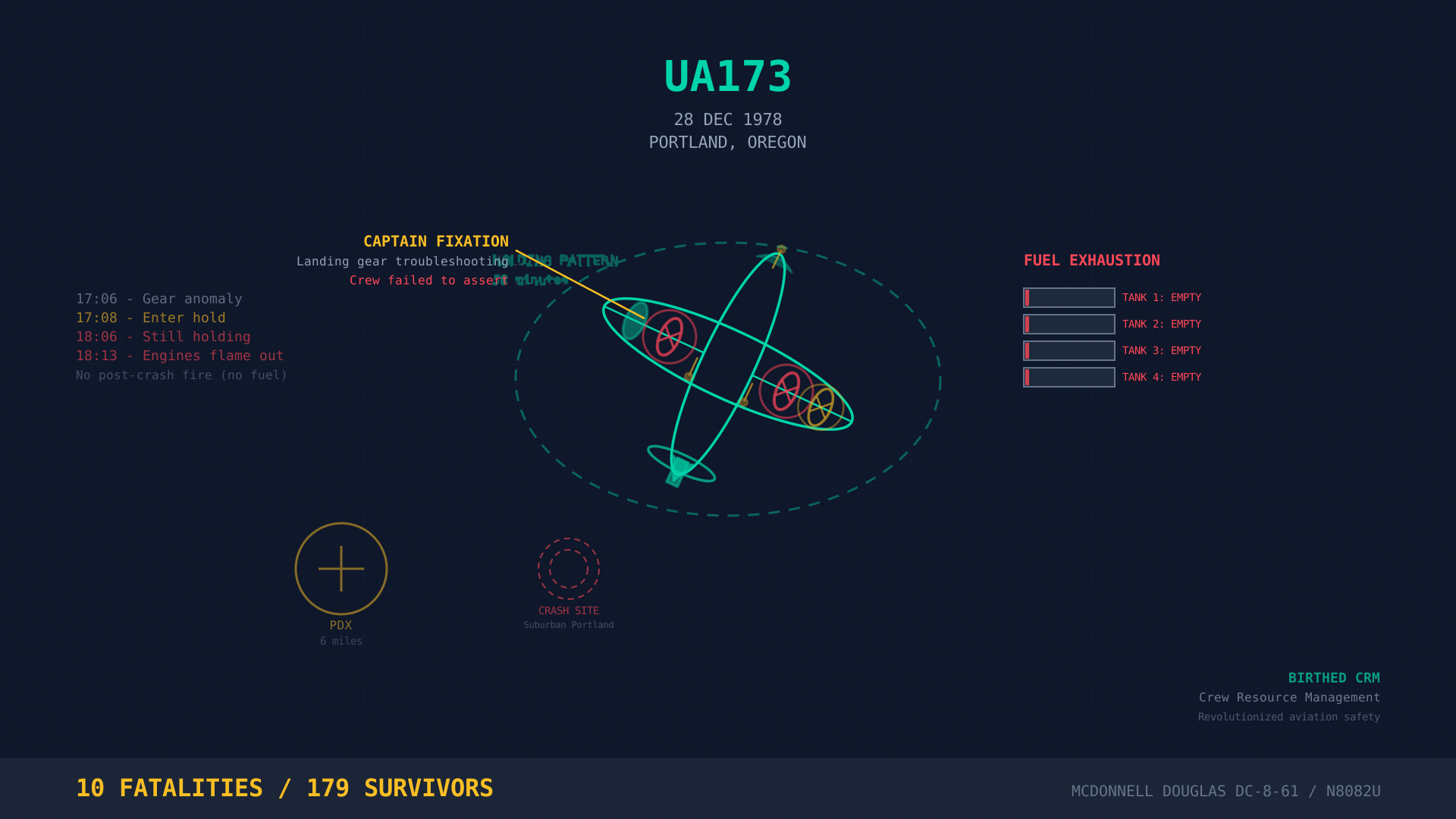
On the evening of December 28, 1978, United Airlines Flight 173 circled over Portland, Oregon, for nearly an hour while Captain Malburn McBroom troubleshot a landing gear problem. The landing gear had extended, but an indicator light suggested it might not be down and locked. McBroom, a meticulous and experienced pilot, wanted to be certain the gear was safe before attempting to land.
In the cockpit, the first officer and flight engineer grew increasingly concerned about fuel. They mentioned it to the captain—indirectly, politely, deferentially. But they did not forcefully communicate the urgency of the situation. And Captain McBroom, focused intensely on the landing gear problem, did not fully grasp how critical the fuel state had become.
At 6:15 PM, still circling, still troubleshooting, the DC-8's engines began flaming out one by one as the fuel tanks ran dry.
The aircraft crashed into a wooded residential area near Portland, Oregon. Ten people died—8 passengers and 2 crew members. But 181 others survived.
United Airlines Flight 173 had the lowest fatality count of any major accident in this archive. But its impact on aviation safety was among the greatest. The crash exposed a fundamental flaw in how flight crews communicated and made decisions—a flaw that had contributed to countless other accidents.
The National Transportation Safety Board's investigation led directly to the development of Crew Resource Management (CRM), a revolutionary training program that transformed cockpit culture and became standard throughout the world. Today, every airline pilot learns the lessons of United 173: speak up, listen, communicate, work as a team.
The 10 people who died that evening in Portland did not die in vain. Their tragedy sparked a safety revolution that has saved countless thousands of lives in the decades since.
The Flight
United Airlines Flight 173 was a scheduled domestic flight from John F. Kennedy International Airport in New York to Portland International Airport in Oregon, with a stop in Denver. On December 28, 1978, the aircraft was a McDonnell Douglas DC-8-61, registration N8082U, a stretched version of the four-engine jet airliner.
Captain Malburn McBroom, 52, commanded the flight. An experienced pilot with over 27,000 flight hours—including extensive time in the DC-8—McBroom was known as thorough, professional, and by-the-book. First Officer Roderick Beebe, 45, occupied the right seat. Flight Engineer Forrest Mendenhall, 41, managed the aircraft's systems from his panel.
The flight carried 181 passengers and 8 crew members. Many were traveling to Portland for the holidays. The flight from Denver had been routine—smooth, on time, and uneventful.
As Flight 173 began its descent toward Portland at approximately 5:00 PM local time, everything seemed perfectly normal.
The Landing Gear Anomaly
At 5:06 PM, approaching Portland from the south, Captain McBroom instructed First Officer Beebe to extend the landing gear. Beebe moved the gear lever to the down position.
Immediately, the crew felt and heard an abnormal vibration and a loud "thump." The aircraft yawed slightly. Captain McBroom felt the control yoke move in an unusual way.
First Officer Beebe: "I didn't get a green light. That's funny."
The landing gear position indicators showed two green lights—for the nose gear and right main gear—but no green light for the left main gear. Without all three green lights, the crew could not confirm that all landing gear were down and locked.
The loud noise and unusual vibration suggested something was wrong with the left main landing gear. Had it extended properly? Was it locked? Had something broken?
Captain McBroom's experience told him this was potentially serious. Landing with the gear not fully extended or locked could result in a collapse, potentially causing the aircraft to cartwheel, break apart, and catch fire.
He made a decision: they would not land until he was certain the gear was safe.
Entering the Hold
At 5:08 PM, Captain McBroom declared a landing emergency with Portland Approach Control and requested a holding pattern to troubleshoot the problem.
Air traffic control cleared Flight 173 to hold southeast of Portland at 5,000 feet. McBroom slowed the aircraft, configured it in a holding pattern, and began working through the problem methodically.
He asked Flight Engineer Mendenhall to review the landing gear system and check for any indications of malfunction. He requested that the flight attendants look out the windows to visually inspect the left main gear. He consulted the DC-8's emergency procedures checklist.
A United Airlines maintenance facility was located at Portland International. McBroom established radio contact with United maintenance personnel, describing the problem and asking for their input.
The troubleshooting consumed McBroom's attention. He was doing exactly what his training and experience told him to do: identify the problem, gather information, make an informed decision, ensure passenger safety.
But while he focused on the landing gear, another problem was developing—one that would prove far more dangerous.
The Fuel State
When Flight 173 entered the holding pattern at 5:08 PM, the DC-8 had approximately 7,000 pounds of fuel remaining—enough for about 45 minutes of flight at holding speed.
The flight plan had allocated adequate fuel for the trip from Denver to Portland with required reserves. But the diversion into holding was consuming fuel that had been planned as reserve.
Flight Engineer Mendenhall monitored the fuel gauges. As the minutes ticked by, he could see the fuel quantity decreasing. By 5:25 PM—17 minutes into the hold—fuel had dropped to about 5,000 pounds.
At 5:38 PM, Mendenhall made his first mention of fuel to Captain McBroom:
Mendenhall: "We got about three thousand pounds on the fuel and that's it."
But the comment was indirect, passive. Mendenhall did not say "Captain, we need to land now." He simply stated a fact.
McBroom acknowledged with a brief "Okay" and continued troubleshooting the landing gear.
The Crew's Concerns
As the holding pattern continued, both First Officer Beebe and Flight Engineer Mendenhall grew increasingly concerned about fuel. But neither forcefully communicated the urgency to Captain McBroom.
The cockpit voice recorder captured their growing anxiety:
At 5:44 PM: Mendenhall: "Fifteen minutes is gonna... really run us low on fuel here."
At 5:50 PM: Beebe: "How much fuel we got, Frostie?" Mendenhall: "Five thousand." Beebe to McBroom: "Fifteen minutes worth?" Mendenhall: "Well, it's not gonna to be more, probably about... a couple hundred pounds."
At 5:53 PM: Mendenhall: "We've got about three on the fuel."
At 6:06 PM: Mendenhall: "We got about four thousand pounds."
The comments were indirect, understated, and deferential. Neither crew member stated clearly: "Captain, we are running out of fuel and must land immediately."
And Captain McBroom, absorbed in the landing gear problem and coordinating with maintenance, did not recognize the critical nature of the fuel situation.
Cockpit Culture in the 1970s
To understand why the crew did not communicate more forcefully, one must understand cockpit culture in the 1970s.
Airline captains were authority figures—often former military pilots accustomed to command structures where subordinates did not question superiors. First officers and flight engineers were expected to defer to the captain's judgment. Challenging a captain's decision was considered insubordinate.
This hierarchical culture—sometimes called "power distance"—pervaded aviation. Junior crew members who spoke up too forcefully risked their careers. Captains who were challenged sometimes retaliated.
The unspoken rule was: make your concerns known, but politely and indirectly. If the captain doesn't take action, accept his judgment. He's the captain.
This culture had contributed to numerous accidents. But before United 173, the industry had not fully recognized the danger or developed systematic solutions.
The Decision to Land
At 6:06 PM, nearly an hour into the holding pattern, Captain McBroom finally decided to attempt a landing. The troubleshooting had not revealed any definitive problem with the landing gear. Visual inspection suggested it was down. He had briefed the flight attendants on emergency evacuation procedures.
It was time to land.
But by now, the fuel situation was critical. The DC-8 had been in the holding pattern for 58 minutes, most of it with the landing gear extended—a configuration that significantly increased fuel consumption.
McBroom began coordinating with air traffic control for an approach to Runway 28L. He discussed the approach with the first officer, ran through checklists, and prepared the cabin crew.
At 6:13 PM: Beebe: "I think you just lost number four engine." Mendenhall: "Yep." McBroom: "Why?" Beebe: "Fuel!"
At 6:13:38 PM: Mendenhall: "We're going to lose an engine!" McBroom: "Why?" Beebe: "Fuel! We're losing an engine!" McBroom: "Why?" Beebe: "Fuel! We're—"
At 6:13:46 PM, Engine 4 flamed out. Seven seconds later, Engine 2 flamed out. The DC-8 was now flying on two engines.
The Crash
At 6:14:05 PM, Engine 3 flamed out. Engine 1 was the last to fail, at 6:14:46 PM.
Flight 173 had run completely out of fuel.
McBroom attempted to glide the now-powerless DC-8 toward the airport, but they were still six miles from the runway. Without engines, the DC-8 could not maintain altitude. It began descending rapidly.
At 6:15:03 PM, McBroom realized they would not reach the airport:
McBroom: "Get some cross-feeds open there or something." Mendenhall: "They're all open." Beebe: "All four engines are gone."
At 6:15:27 PM: McBroom: "Okay. We're going down, and we're not going to make it to the airport."
The DC-8 descended into a wooded area near 157th Avenue and East Burnside Street in suburban Portland, approximately six miles southeast of the airport. The aircraft struck trees and power lines, shearing off the right wing and tail section. The fuselage broke into multiple sections as it crashed through the forest.
The lack of fuel meant there was no post-crash fire—a fortunate circumstance that saved many lives.
The Survivors and the Dead
When rescuers arrived, they found the DC-8's wreckage scattered through a wooded area. The forward fuselage had broken apart, but much of the center cabin section remained relatively intact.
Of the 189 people aboard, 179 survived. Many were seriously injured—broken bones, lacerations, internal injuries—but alive. The lack of fire allowed passengers time to escape or to be rescued from the wreckage.
Ten people died:
- Eight passengers, most killed by the impact forces when the forward fuselage broke apart
- Two cabin crew members, both in areas of severe structural failure
Captain McBroom, First Officer Beebe, and Flight Engineer Mendenhall all survived with serious injuries.
For the survivors, relief mixed with anguish. They had survived an aircraft crash, but 10 of their fellow passengers and crew were dead. And as the investigation would reveal, all of them—the dead and the living—had been put at risk by a failure that should never have happened.
The Investigation
The National Transportation Safety Board investigation focused on a central question: how did a modern airliner with experienced crew run completely out of fuel?
The landing gear anomaly, investigators determined, had not been particularly serious. The left main gear had in fact extended and locked properly. The unusual sounds and vibrations had been caused by the normal extension sequence, possibly exacerbated by airframe flex. The missing indicator light was likely a burnt-out bulb.
In other words, Flight 173 could have landed safely at any time during that hour-long hold. The landing gear was fine.
The NTSB examined the fuel management:
- Flight 173 had departed Denver with adequate fuel for the trip to Portland plus required reserves
- Entering a one-hour holding pattern consumed the reserve fuel
- The crew had fuel quantity indicators available and functioning
- The flight engineer had repeatedly mentioned fuel state to the captain
- The captain had not recognized the criticality of the fuel situation until engines began failing
The NTSB's final report assigned probable cause:
"The failure of the captain to monitor properly the aircraft's fuel state and to properly respond to the low fuel state and the crewmember's advisories regarding fuel state. This resulted in fuel exhaustion to all engines. His inattention resulted from preoccupation with a landing gear malfunction and preparations for a possible landing emergency."
But critically, the NTSB also identified a contributing factor:
"The failure of the other two flight crewmembers either to fully comprehend the criticality of the fuel state or to successfully communicate their concern to the captain."
The Birth of Crew Resource Management
The NTSB's analysis went beyond individual blame. The investigation identified systemic failures in how flight crews communicated and made decisions.
In its findings, the Board noted that this was not an isolated case. Numerous accidents had involved failures of crew coordination, communication breakdowns, and captains who either ignored or did not hear crew warnings.
The NTSB recommended that airlines develop training programs focused on crew coordination, communication, decision-making, and leadership—programs that would later become known as Crew Resource Management (CRM).
United Airlines, recognizing the systemic issues revealed by Flight 173, became the first airline to implement such training. In 1980—just two years after the crash—United instituted what it called "Command/Leadership/Resource Management" training for all flight crews.
The program taught:
- Communication: How to clearly and assertively communicate concerns, especially to superiors
- Leadership: How captains should create an environment where crew members feel empowered to speak up
- Decision-making: How to use all available resources (crew, checklists, maintenance, ATC) to make informed decisions
- Situational awareness: How to maintain awareness of the aircraft's state and not fixate on single problems
- Assertiveness: How to escalate concerns if initial communication doesn't get appropriate response
Other airlines quickly adopted similar programs. By the late 1980s, CRM training was widespread. Today, it is mandatory worldwide and considered one of aviation's most important safety innovations.
The Five-Step Assertion Process
One of the most important tools to emerge from CRM training was the Five-Step Assertion Process, designed to help crew members progressively escalate concerns:
- Opening/Attention getter: "Captain..." or "Hey..."
- State concern: "I'm concerned about our fuel state."
- State the problem: "We have 3,000 pounds remaining, which gives us about 15 minutes."
- State a solution: "I think we need to land immediately."
- Obtain agreement: "Do you agree we should land now?"
If these steps don't work, the crew member is taught to take control if safety is at risk.
This process empowers crew members to be assertive without being insubordinate, and it gives captains a clear structure for receiving and acting on concerns.
On Flight 173, the flight engineer and first officer never progressed beyond stating facts (step 2-3). They never clearly stated a solution or demanded agreement. Had they been trained in modern CRM, the tragedy might have been prevented.
Captain McBroom's Reflection
In the years after the accident, Captain McBroom spoke publicly about Flight 173. He acknowledged his mistakes and became an advocate for CRM training.
"I thought I was monitoring the fuel," he said in later interviews. "But I was so focused on the landing gear that I wasn't processing what my crew was telling me. They were trying to warn me, but I didn't hear the urgency."
McBroom emphasized that he didn't deliberately ignore his crew. He simply didn't understand how critical the situation had become. The indirect, deferential way they communicated did not break through his fixation on the landing gear problem.
"If my flight engineer had said, 'Captain, we must land now or we'll crash,' I would have landed immediately," McBroom reflected. "But that's not how we talked to each other back then."
Legacy and Impact
United Airlines Flight 173 is one of the most studied accidents in aviation history—not because of its death toll (relatively low) or its technical complexity (relatively simple), but because of its profound impact on safety culture.
The accident demonstrated that:
- Fixation is dangerous: Even experienced, professional pilots can become so focused on one problem that they lose situational awareness
- Hierarchy can kill: When crew members are afraid to challenge authority, critical information doesn't reach decision-makers
- Communication must be clear: Indirect, polite hints are not adequate in emergency situations
- Teams are stronger than individuals: The best captain supported by an empowered, assertive crew is safer than a lone authority figure
Every modern CRM training program includes Flight 173 as a case study. Pilots learn what went wrong, why it went wrong, and how to prevent similar accidents.
The impact is measurable. Studies have shown that CRM training has contributed to dramatic reductions in accidents caused by crew coordination failures. Countless accidents have been prevented when crew members spoke up assertively and captains listened.
Safety Changes Beyond CRM
Flight 173 also led to improvements in fuel management procedures:
Low Fuel Procedures: Airlines developed standardized procedures for declaring fuel emergencies and calculating minimum fuel reserves
Fuel Awareness Training: Enhanced training on fuel planning, monitoring, and management
ATC Coordination: Improved protocols for communicating fuel critical situations to air traffic control
Checklists: Enhanced emergency checklists that explicitly include fuel state verification
These technical improvements complemented the cultural changes brought by CRM.
The 10 Who Died
In the focus on Flight 173's safety legacy, the 10 people who died can sometimes be overlooked. But they were not statistics—they were people whose lives had value and whose deaths demand to be remembered:
- Passengers traveling home for the holidays
- Cabin crew members serving their passengers
- People whose families were shattered by the crash
- Individuals whose futures were stolen by a preventable accident
They died because fuel was exhausted while troubleshooting a problem that wasn't really a problem. They died because communication failed. They died because a captain fixated and a crew didn't assert.
Their deaths were not in vain. The lessons learned from Flight 173 have saved thousands—likely tens of thousands—of lives in the decades since.
The Paradox of United 173
United Airlines Flight 173 presents a paradox: it is simultaneously one of aviation's greatest tragedies and one of its greatest success stories.
A tragedy because 10 people died needlessly, because 179 others were placed in mortal danger, because an aircraft crashed due to a completely preventable failure.
A success story because the investigation led to systemic changes that revolutionized aviation safety, because the lessons learned have prevented countless other accidents, because the death of 10 catalyzed safety improvements that have saved multitudes.
This does not make the loss acceptable. The 10 who died deserved to land safely in Portland. Their families deserved to see them walk off that aircraft alive.
But their legacy is profound. Every time a first officer assertively communicates a concern, every time a captain solicits input from the crew, every time a flight engineer states clearly "We must land now"—the lessons of Flight 173 are being applied.
Remembering United 173
There is no grand memorial to United Airlines Flight 173. The crash site in suburban Portland has long since been cleared, the trees regrown, the neighborhood rebuilt.
But in every airline training facility in the world, in every simulator session where CRM is taught, in every flight deck where crew members work together as a team rather than as a hierarchy, the memory of Flight 173 lives on.
The accident stands as a permanent reminder that:
- Communication saves lives
- Teams are stronger than individuals
- Authority without collaboration is dangerous
- Speaking up is not insubordination—it's professionalism
- Listening is not weakness—it's wisdom
Ten people died on December 28, 1978, when United Airlines Flight 173 ran out of fuel and crashed in Portland. Their deaths changed aviation forever.
The next time you fly, the crew in the cockpit will be working together as a team, communicating clearly, supporting each other, sharing situational awareness. They will be practicing Crew Resource Management.
And they will be honoring the memory of Flight 173—the crash that taught aviation how to communicate, collaborate, and save lives.