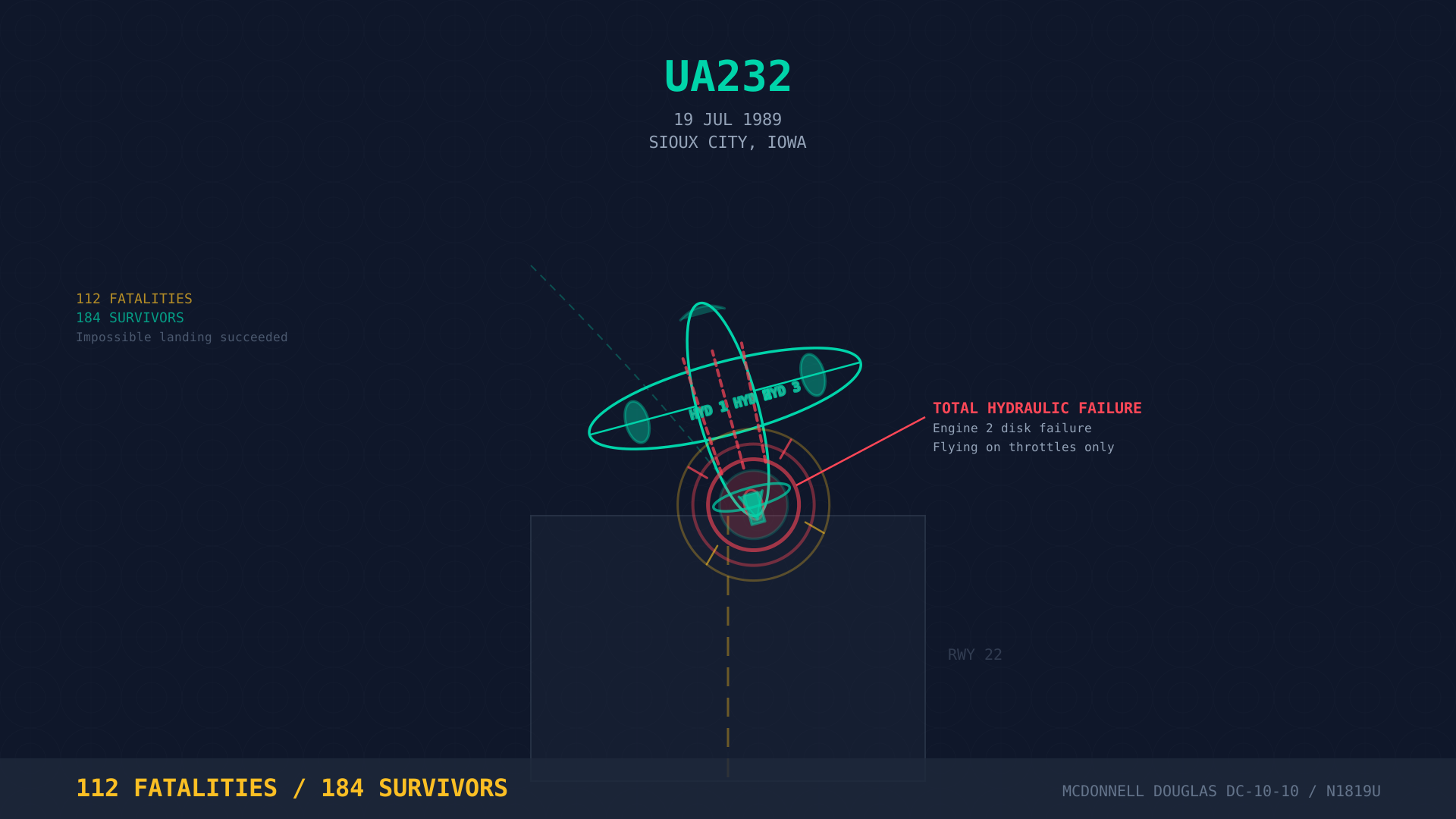
The Impossible Landing
On July 19, 1989, United Airlines Flight 232 was cruising peacefully at 37,000 feet over Iowa when the unthinkable happened: the tail-mounted engine exploded, sending shrapnel through all three of the DC-10's hydraulic systems. In an instant, the aircraft became almost completely uncontrollable, with no hydraulics to move the flight control surfaces.
According to every training manual, every simulation, and every engineering analysis, the aircraft was doomed. Total hydraulic failure was considered so unlikely that no procedure existed to deal with it. The crew should not have been able to fly the plane at all, much less land it.
But Captain Al Haynes and his crew did something extraordinary. Using nothing but differential thrust on the two remaining wing engines—speeding up one, slowing down the other—they managed to guide the crippled aircraft toward Sioux City Gateway Airport. The crash landing that followed was violent, breaking the aircraft into pieces and causing a massive fire.
One hundred twelve people died. But 184 people walked away—a survival rate that investigators later called "a statistical impossibility" and "a miracle of human performance." Flight 232 became aviation's most famous example of how exceptional crew resource management can achieve the impossible.
A Routine Flight
United Airlines Flight 232 departed Denver's Stapleton International Airport at 2:09 PM Mountain Time, bound for Chicago O'Hare with 285 passengers and 11 crew members aboard. The aircraft was a McDonnell Douglas DC-10-10, registration N1819U, first delivered to United in 1971.
Captain Alfred Clair "Al" Haynes, 57, was at the controls. A 33-year veteran of United Airlines, Haynes was known as a calm, methodical pilot who emphasized crew coordination. First Officer William "Bill" Records, 48, sat in the right seat. Second Officer Dudley Dvorak, 51, served as flight engineer.
The flight proceeded normally as the DC-10 climbed to its cruise altitude of 37,000 feet. Weather was clear, systems were functioning perfectly, and the flight was ahead of schedule. Passengers settled in for the short hop to Chicago.
At 3:16 PM Central Time—just over an hour into the flight—everything changed.
The Explosion
The crew felt a shudder and heard a loud bang. The aircraft yawed to the right. Captain Haynes instinctively reached for the control yoke, but it felt strange—sluggish and unresponsive.
In the tail of the aircraft, the number two engine—the DC-10's distinctive tail-mounted engine—had suffered a catastrophic uncontained failure. A titanium fan disk at the front of the engine, weakened by a metallurgical defect that had gone undetected for years, had fractured and disintegrated. The pieces shot through the engine housing at supersonic speeds like shrapnel from a bomb.
Most of the debris exited the aircraft harmlessly. But several large fragments struck the empennage—the tail section—with devastating precision. The shrapnel severed all three of the DC-10's independent hydraulic systems: lines running through the left side of the tail, the right side, and the center.
Within seconds, all three hydraulic systems lost pressure and drained completely.
Flight 232 had lost all hydraulic power.
The Impossible Scenario
Modern aircraft are controlled by hydraulics: high-pressure fluid lines that power actuators which move the flight control surfaces. On a DC-10, hydraulics control the ailerons (which bank the aircraft), the elevators (which control pitch), the rudder (which controls yaw), the flaps and slats (which provide lift at low speeds), the landing gear, and even the wheel brakes.
The DC-10 had been designed with triple redundancy—three completely independent hydraulic systems, each capable of controlling the aircraft alone. The odds of losing all three systems simultaneously were calculated at roughly one in a billion. McDonnell Douglas engineers had considered it so unlikely that they never developed procedures for total hydraulic failure. Pilots were never trained on how to handle it.
In the cockpit of Flight 232, Captain Haynes and his crew quickly realized the severity of their situation. The control yoke moved freely—too freely. It wasn't connected to anything anymore. The rudder pedals did nothing. The flaps wouldn't extend. The landing gear might not come down.
"We have no hydraulic fluid," Flight Engineer Dvorak reported, his voice tight.
Haynes tried the backup systems. Nothing. He tried the emergency backup. Nothing.
They had absolutely no flight controls.
The Passenger Instructor
As the crew struggled to assess their situation, a passenger in the first-class cabin made an unusual decision. Dennis Fitch, a DC-10 training instructor for United Airlines who happened to be traveling as a passenger that day, had felt the explosion and recognized its severity.
Fitch walked to the front of the aircraft and knocked on the cockpit door. When First Officer Records opened it, Fitch offered his help.
"I'll do whatever you want me to do," he said.
It was an extraordinary offer, and Captain Haynes made an extraordinary decision: he accepted. Fitch entered the cockpit and positioned himself between the two pilots, taking control of the throttles. His job would be to manipulate the throttles on the two wing engines to help steer the aircraft.
This decision—accepting help, using all available resources, communicating openly—would prove crucial. It was crew resource management in its purest form.
Flying on Throttles Alone
The DC-10 still had two functioning engines—one on each wing. By increasing power on one engine and decreasing it on the other, the crew found they could induce a banking turn. Increasing power on the left engine would bank the aircraft right. Increasing power on the right engine would bank it left.
But the controls were crude and the aircraft's response was delayed by several seconds. The DC-10 was also oscillating in a slow but unavoidable cycle called a phugoid—a gentle porpoising motion where the nose pitched up and down while the aircraft climbed and descended in long waves.
Captain Haynes tried to turn the aircraft toward the nearest suitable airport: Sioux City Gateway Airport, about 60 miles away. Using differential thrust, he managed to coax the aircraft into a slow right turn. But turning left proved almost impossible. They could only make right turns.
Air traffic controllers began clearing airspace. Emergency services at Sioux City went on full alert. The crew declared an emergency and began trying to figure out how—or whether—they could land.
The Approach
The challenge facing Flight 232 was immense:
- They had no control over their rate of descent. The phugoid cycle meant the aircraft would arrive at the runway descending at 1,800 feet per minute—three times faster than a normal landing.
- They had no flaps or slats, meaning their landing speed would be around 220 mph instead of the normal 140 mph.
- They couldn't control their heading precisely. The aircraft was essentially aiming itself; the crew could only make minor adjustments.
- They had no nose-wheel steering and possibly no brakes.
- They would get exactly one attempt. There would be no go-around, no second chance.
Captain Haynes told the flight attendants to prepare for a crash landing. The cabin crew briefed passengers on brace positions and emergency exits. Everyone knew this would be violent.
Dennis Fitch stood at the throttle console, making continuous tiny adjustments to the engine power settings. Captain Haynes and First Officer Records worked the controls—even though they knew the surfaces wouldn't respond—hoping against hope that some hydraulic pressure might return.
At 4:00 PM, Flight 232 approached Sioux City from the northwest. The crew had intended to land on Runway 31, the airport's longest runway. But as they descended, it became clear they were slightly off course.
They were lined up with Runway 22 instead—a shorter runway, oriented differently. There was no way to correct their heading enough to switch runways.
"We're not going to make the runway, folks," Haynes told air traffic control.
The Crash
At 4:00 PM, United Airlines Flight 232 descended toward Runway 22 at Sioux City Gateway Airport. The DC-10 was coming in fast—too fast—and descending rapidly. The right wing dipped lower and lower as Fitch and Haynes struggled with the throttles.
The right wing tip struck the runway first, at a point about halfway down its length. The impact tore the wing from the fuselage. The number three engine—the right wing engine—broke loose and tumbled ahead of the disintegrating aircraft, cartwheeling down the runway in a spray of sparks.
The fuselage cart-wheeled. Sections broke apart. The aircraft's momentum carried the wreckage across the runway and into a nearby cornfield. Fire erupted immediately.
From impact to final rest took just forty-three seconds. When it was over, the aircraft had broken into several large sections, with survivors and casualties scattered across the crash site.
The Rescue
Emergency crews had positioned themselves around the airport in anticipation of exactly this scenario. Within seconds of the crash, they were moving. Fire trucks sprayed foam on the burning wreckage. Paramedics rushed toward survivors staggering from the cornfield.
The tail section had broken off and separated from the main fuselage early in the sequence. Passengers in that section had a relatively controlled deceleration, and many walked away with minor injuries.
The center section—where most of the passengers sat—had tumbled violently. Some passengers were thrown from the aircraft. Others were trapped in the wreckage. The fire spread quickly through this section.
The cockpit section had broken free and landed upside down in the cornfield. Incredibly, Captain Haynes, First Officer Records, and Dennis Fitch all survived, though they suffered serious injuries.
When the count was finally complete, 112 people had died: 110 passengers and 2 flight attendants. But 184 people survived—including an 11-month-old infant who was found alive in the wreckage, still strapped in her mother's arms. Her mother did not survive.
The Investigation
The National Transportation Safety Board launched an immediate investigation. Investigators quickly focused on the failed engine. They recovered the fractured fan disk from a cornfield where it had landed several miles from the airport.
Metallurgical analysis revealed a startling flaw. In 1971, when the titanium disk was being forged at a manufacturing plant in Utah, a small defect occurred—a nitrogen-rich region created a hard, brittle inclusion in the metal, approximately the size of a fingernail. This inclusion created a tiny crack.
For eighteen years, through 15,503 takeoff and landing cycles, that crack slowly grew larger as the disk spun at high speed thousands of times. Inspections failed to detect it. Ultrasonic testing—the standard inspection method—couldn't see it because of the way the crack was oriented in the metal.
On July 19, 1989, the crack reached critical length. The disk fractured, releasing all the energy stored in the spinning metal. The disk disintegrated.
The NTSB concluded that the metallurgical defect was undetectable with the inspection methods available at the time. The failure itself was essentially unavoidable.
But the design of the DC-10's hydraulic system came under intense scrutiny. While the three systems were independent in theory, they all ran through the tail section in close proximity. A single event—like an engine explosion—could damage all three systems simultaneously.
McDonnell Douglas had assessed this risk and deemed it acceptable given the extremely low probability of a catastrophic tail engine failure. The Flight 232 accident proved that assessment wrong.
The Impossible Made Possible
What made Flight 232 truly remarkable was not the crash itself, but the fact that anyone survived at all.
Investigators used flight simulators to recreate the conditions of Flight 232. Experienced test pilots attempted to land a DC-10 with total hydraulic failure, using only differential thrust for control.
None of them succeeded. Most couldn't even get the aircraft to the airport. Those who did crashed with 100% fatalities in the simulation.
The NTSB concluded that the crew's achievement was "highly commendable and greatly exceeded reasonable expectations."
Several factors contributed to the crew's success:
Crew Resource Management: Captain Haynes exemplified modern CRM principles. He immediately recruited Dennis Fitch, delegated tasks clearly, communicated openly, and maintained calm. When asked later about his role, Haynes famously said, "I was just the most visible person in a group of 295 very calm people who did their jobs professionally."
Experience and Skill: The crew had a combined total of over 100,000 flight hours. That experience allowed them to improvise solutions to problems that had no precedent.
Luck: The aircraft's phugoid oscillation happened to be in the "descent" phase at the moment of impact, which reduced the vertical speed slightly. The right turn that brought them to Runway 22 instead of Runway 31 may have actually helped, as it gave them a shorter approach. The weather was clear.
Emergency Response: Sioux City's emergency services had conducted a disaster drill just a year earlier for a scenario uncannily similar to what actually occurred. Their preparedness saved lives.
Safety Changes
United Airlines Flight 232 led to significant aviation safety improvements:
Hydraulic System Design: Manufacturers redesigned hydraulic systems to ensure greater separation of redundant lines. Some aircraft now include a fourth independent hydraulic system specifically to address this failure mode.
Engine Containment: The FAA mandated improved containment around engine fan disks to prevent fragments from damaging critical systems.
Inspection Procedures: New ultrasonic inspection techniques and fluorescent dye penetrant inspections were developed to detect manufacturing defects in titanium components.
Crew Resource Management: The accident became the gold standard for CRM training. Captain Haynes' decision to use Dennis Fitch and his open communication style are now taught to pilots worldwide.
Cockpit Training: Simulators now include scenarios for flying on throttles alone, despite the extreme unlikelihood of total hydraulic failure.
Manufacturing Quality Control: Titanium forging processes were improved to prevent the kind of metallurgical defect that created the initial crack.
Captain Haynes' Legacy
Captain Al Haynes became an ambassador for aviation safety. He spent years after the accident giving presentations on CRM and the lessons of Flight 232. He never claimed personal credit for the survival of 184 people.
"If you can't accept criticism, you shouldn't be in the cockpit," he often said. "And if you do accept it, you should be willing to give some."
When asked if he was a hero, Haynes would redirect the question: "The real heroes are the flight attendants who prepared the cabin, the rescue workers who pulled people from the wreckage, and the passengers who helped each other survive."
He maintained close relationships with survivors for the rest of his life. Many credited him with giving them a second chance at life. Haynes died in 2019 at age 87.
Dennis Fitch, the off-duty training instructor who volunteered to help in the cockpit, suffered from post-traumatic stress after the accident. He struggled with survivor's guilt, knowing that 112 people had died while he lived. But he too became an advocate for aviation safety, speaking about the accident and its lessons. He died in 2012 at age 69.
The Survivors' Reunion
Every five years, survivors of Flight 232 gather in Sioux City for a reunion. They tour the crash site, now marked by a memorial garden. They thank the emergency responders who saved them. They remember those who didn't make it.
The survivors include Jerry Schemmel, who pulled an infant from the wreckage and went on to become a sports broadcaster; Jeremiah Samson, who was just 10 months old and became known as the "Miracle Baby"; and countless others who rebuilt their lives after July 19, 1989.
Their stories are testament to human resilience, to the training and dedication of aviation professionals, and to the power of teamwork under the most extreme circumstances.
The Unanswerable Question
One question haunts the Flight 232 story: could more people have survived?
The NTSB found that some passengers who survived the initial impact died in the post-crash fire. Some were trapped in their seats and could not escape quickly enough. The intense heat and smoke killed them before rescuers could reach them.
In the years since, aircraft cabin safety has improved dramatically. Seats are now designed to withstand greater impact forces. Cabin materials are more fire-resistant. Emergency lighting systems are more robust. Evacuation procedures are better.
But the fundamental truth remains: a crash landing at 220 mph with no flight controls is survivable only through a combination of skill, preparation, and fortune. Flight 232 had all three.
Legacy
United Airlines Flight 232 remains one of aviation's most studied accidents. The aircraft's cockpit voice recorder captured the crew's calm professionalism in the face of impossible circumstances. Their communication, their problem-solving, and their use of every available resource became the template for modern CRM.
The accident proved that redundant systems are only truly redundant if they cannot fail together. It demonstrated that the line between disaster and miraculous survival is often measured in the competence and character of the humans making split-second decisions.
Most importantly, Flight 232 showed that even when the engineering fails, even when the aircraft is broken beyond its designed limits, human ingenuity and teamwork can still save lives.
One hundred twelve people died that day in Sioux City. They deserved to live, and their deaths drove meaningful safety improvements.
But 184 people walked away from a crash that every simulation said should have killed everyone aboard. They lived because a group of professionals refused to accept the impossible, worked together flawlessly, and flew an unflyable aircraft just well enough to give survival a chance.
In the words of Captain Al Haynes: "We were just doing our job. But I'm very, very glad that 184 people got to go home that day."